
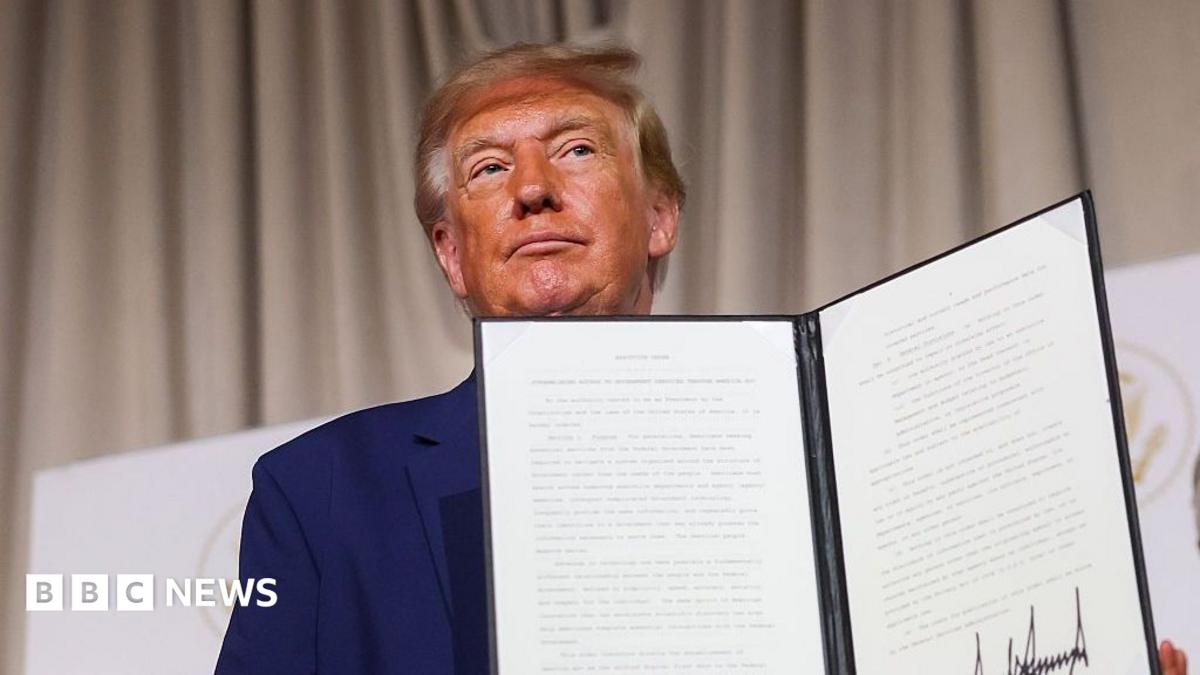
US President Donald Trump has firmly dismissed the idea of any collaborative artificial intelligence venture with China, warning that such a partnership would amount to handing America's technological secrets to its principal economic competitor. His remarks, delivered during a public event in Washington on Tuesday, underscore a hardening stance on AI cooperation even as the two nations have recently established channels for dialogue.
Speaking at the launch of America.gov—a new AI-driven web portal designed to simplify access to federal government services—Trump argued that the United States currently enjoys a substantial lead in the AI sector and has no intention of sharing that advantage with potential rivals. He stated that the US is "leading by a lot" and should avoid any arrangement that could blur the lines between cooperation and competition.
The president's comments came just days after Chinese President Xi Jinping visited the White House, where the two sides announced the creation of a new AI dialogue and agreed to hold further talks in November. The two countries also set up a communications mechanism aimed at preventing misunderstandings during AI-related incidents. Despite these diplomatic steps, Trump made clear that his opposition to joint development remains unchanged.
At Tuesday's event, Trump explained that any joint venture would inevitably involve revealing sensitive know-how that China or other competitors would covet. He said that mixing it up with potential rivals would mean giving away "a lot of secrets" that the US currently holds. In his view, the global AI race is effectively a two-horse contest between Washington and Beijing, with no meaningful third contender.
Trump also revealed that artificial intelligence was among the topics discussed during his meeting with Xi last week. Nevertheless, he insisted that his position against collaborative development has not softened. He warned that joint cooperation would allow China to "immediately gain access to things that we know that they don't know," and he stressed his determination to preserve America's current lead over China and all other nations. "We're leading now over China and everyone else, and I want to keep it that way," he said.
The president's firm stance stands in contrast to warnings from Beijing. Ahead of the Trump-Xi meeting, China's foreign ministry cautioned that "narratives of threat" and confrontation are detrimental to effective AI governance. The Chinese side has consistently advocated for international cooperation on AI safety and development, framing restrictive or adversarial approaches as counterproductive to global technological progress.
On the domestic front, Trump is facing growing public anxiety about the potential dangers of artificial intelligence, along with louder calls for regulatory guardrails. A Politico poll released in late September found that two out of three Americans believe there is at least a moderate risk that AI could destroy humanity. The same survey indicated that 44% of Trump's own supporters would prefer a pause in AI development, reflecting unease even within his political base.
Despite these concerns, the president has repeatedly dismissed safety fears. He has labeled them a "hoax" and compared them to what he calls the "global warming scam," which he claims is being perpetrated by radical left Democrats. His skepticism toward AI regulation aligns with his broader deregulatory philosophy, particularly on emerging technologies that he views as central to economic and strategic competitiveness.
Trump's resistance to any joint venture with China signals that the US will continue to pursue a unilateral path in AI development, prioritizing national advantage over bilateral collaboration. This approach could complicate the newly established AI dialogue, which was intended to manage risks and reduce the chance of accidental escalation. Analysts note that without some level of communication and shared understanding, the risk of missteps in such a critical and fast-evolving domain may grow.
The launch of America.gov itself reflects the administration's enthusiasm for embedding AI into government operations. The portal is designed to streamline services and improve efficiency, showcasing the president's belief that AI is a tool for national renewal rather than a threat to be contained. The event served as a backdrop for his broader message: the US will embrace AI aggressively, but it will not share its edge with China.
While the November talks are still scheduled, the contours of the dialogue remain uncertain. Trump's explicit rejection of joint development suggests that the discussions will focus narrowly on risk management and communication channels, rather than any substantive technological partnership. For Beijing, which has emphasized the importance of global AI governance, the US position may reinforce its narrative that Washington is pursuing confrontation rather than cooperation.
The political implications at home are also significant. Trump's stance resonates with supporters who view China as a strategic rival and who favor a hard line on technology transfer. Yet the same stance may alienate those within his coalition who worry about AI's long-term risks and want to see more caution. By dismissing safety concerns so vocally, Trump is betting that his base prioritizes competitive advantage over precautionary regulation.
Internationally, the US position could accelerate a bifurcation of the global AI landscape, with China and the US leading separate technological spheres. Allies and other nations may face pressure to choose sides or develop their own capacities. The absence of a joint US-China framework could also hinder efforts to establish shared safety standards, leaving a gap that multilateral bodies may struggle to fill.
As the November dialogue approaches, the White House has not indicated any shift in Trump's position. The president remains intent on keeping America first in AI, and he appears willing to accept the diplomatic and regulatory consequences of that approach. Whether this strategy yields lasting advantage or simply deepens divisions will depend on how both nations manage their rivalry in the months ahead.








(0)