
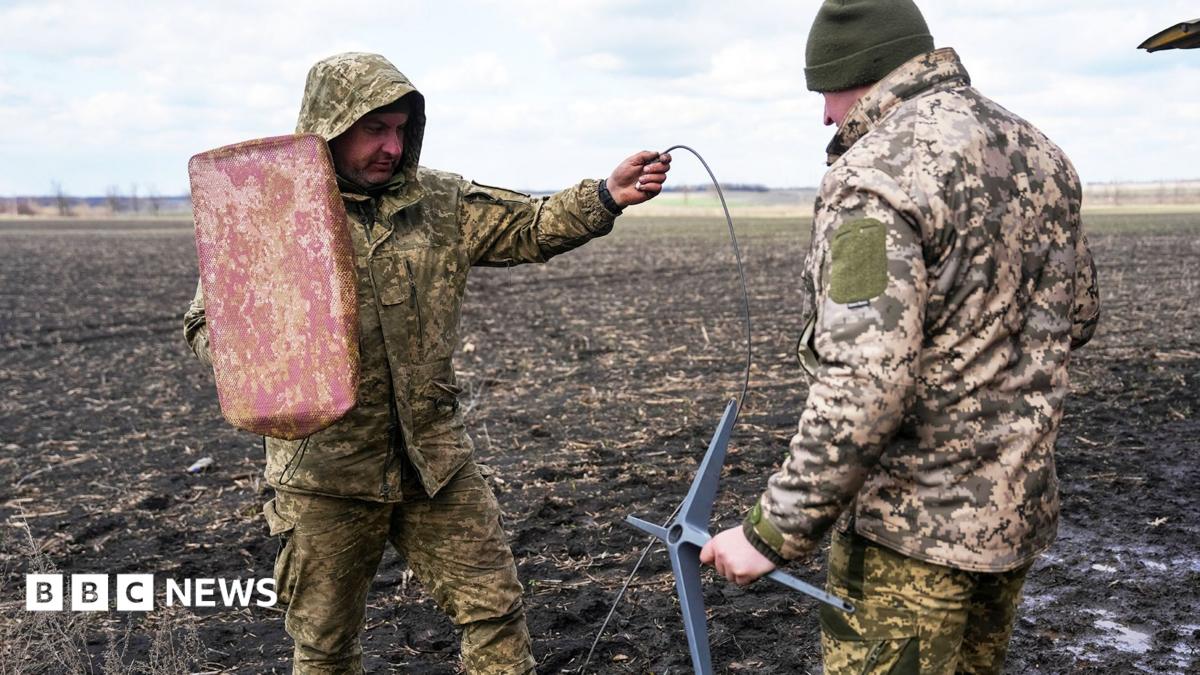
New speed restrictions imposed on Starlink satellite internet terminals operating inside Ukraine have disrupted a number of battlefield "missions," according to an adviser to President Volodymyr Zelensky, who suggested the timing of the move was politically motivated rather than technical.
Serhiy Beskrestnov, a Ukrainian military communications specialist who advises the president, said the limits were introduced overnight by Elon Musk's SpaceX company without prior notification to Kyiv. The change caps connectivity for terminals travelling faster than 100mph (160km/h), a threshold that Ukrainian officials say is easily exceeded by the vehicles and aerial platforms used to conduct drone operations.
In a post on Telegram on Wednesday, Beskrestnov said SpaceX had "implemented overnight a speed limit on Starlink terminals" and that the measure had already resulted in "the disruption of a number of missions." He added that the decision "cannot be a coincidence and is related to the current political situation." SpaceX has not commented publicly on the reported restrictions.
The Starlink network has become an indispensable tool for Ukraine's armed forces since Russia's full-scale invasion in 2022. Its low-orbit satellites provide secure, high-bandwidth connections that allow troops to guide drones toward Russian targets, relay signals across the front line, and coordinate air defence efforts, including the interception of Russian munitions. For a military that operates with limited conventional communications infrastructure, Starlink has effectively served as a battlefield backbone.
According to Beskrestnov, the speed limit is especially damaging to Ukraine's ability to use interceptors against Russia's newly developed jet-propelled drones. In a follow-up post, he stressed that Starlink remains the most effective tool for guiding those interceptors to their targets, meaning any degradation in connectivity directly undermines one of Kyiv's most important defensive capabilities.
A source in Ukraine's defence ministry later confirmed to the BBC that restrictions had been detected affecting Starlink connectivity at speeds above 160km/h. The source said the "root cause" of the problem was still being investigated, suggesting Kyiv had not yet received a full explanation from the company.
Defence ministry sources went on to explain the practical consequences: once a vehicle or asset exceeds the 160km/h threshold, the terminal loses its connection. That, they said, makes it harder to carry out drone operations — "specifically interceptors and middle-strike drones" — and also degrades "capabilities for front line logistics, reconnaissance, and signal relaying."
The timing of the restriction is particularly sensitive. In February, Musk's decision to deny Russian forces access to Starlink helped blunt Moscow's advance and caused confusion among Russian commanders, underlining how significantly the network can shape the trajectory of the war. The new limits, by contrast, appear to constrain Ukrainian operations, prompting Beskrestnov's suggestion of a political dimension.
The development comes amid heightened diplomatic tension between Kyiv and Washington. Zelensky has said the United States threatened to restrict intelligence sharing if he did not sign up to President Donald Trump's proposed "energy ceasefire." On Tuesday, Trump denied that Washington was withholding intelligence from Ukraine.
Ukraine depends heavily on US satellite systems to track incoming Russian missiles so that it can issue air raid alerts and attempt interceptions. Yet over the past two nights, missiles struck targets in the Ukrainian capital without any warning before air raid sirens could sound — a failure that has raised alarm about the reliability of the warning pipeline.
According to Ukraine's air force, Russia launched 39 ballistic and cruise missiles and 128 drones overnight. Four of those missiles and 115 drones were shot down, it said. It was the second consecutive night that Kyiv was hit by Russian missiles.
The strikes came as Zelensky prepared to meet UK Prime Minister Andy Burnham at Downing Street on Wednesday to discuss accelerating air defence supplies to Kyiv. The meeting underscores the urgency with which Ukraine is seeking to shore up its defensive capabilities ahead of another winter of attacks on energy infrastructure.
The human cost of the overnight strikes was severe. Zelensky said at least 600,000 people across Ukraine were left without electricity following deadly Russian missile and drone attacks. He added that "critical" energy infrastructure had been hit in Kyiv and the surrounding region, as well as in the north-eastern city of Kharkiv — despite Trump's claim on Sunday that an "energy ceasefire" was in place between Russia and Ukraine.
Three people were killed in Kyiv, local officials reported, while Russia said its "massive" strikes had targeted communications and energy facilities used by Ukraine's military. Later on Wednesday, at least six people were killed in a Russian drone strike on a warehouse in the north-western city of Lutsk, according to local officials.
On Sunday, Trump wrote on Truth Social: "Effective immediately, there is an ENERGY CEASEFIRE in the War between Russia and Ukraine. Both parties have agreed. Do not break it!" Zelensky has since repeatedly said Ukraine is ready to halt its strikes on Russian oil refineries and other energy facilities if Moscow does the same. But Russia's Foreign Minister Sergey Lavrov has said Ukraine does not deserve the "respite" a ceasefire would bring, adding that under any truce Europe would be able to "pump [Ukraine] with new weapons," enabling it to continue the war.
Vladimir Putin launched a full-scale invasion of Ukraine in 2022, and Moscow currently controls about 20% of Ukrainian territory. Meanwhile, Russia's defence ministry said 902 Ukrainian drones had been shot down overnight over a number of Russian regions, including Moscow and Crimea, the southern peninsula annexed by Russia in 2014.
For ordinary Ukrainians, the past two nights have been terrifying. Tetiana Storozhyk, 54, told the BBC she lost everything "in a fraction of a second" when a late-night blast struck her apartment block in Kyiv on Tuesday. Images from the capital showed residents, some still in their pajamas, with bloodied faces as emergency services worked at the scenes of the strikes.






Comments (0)