
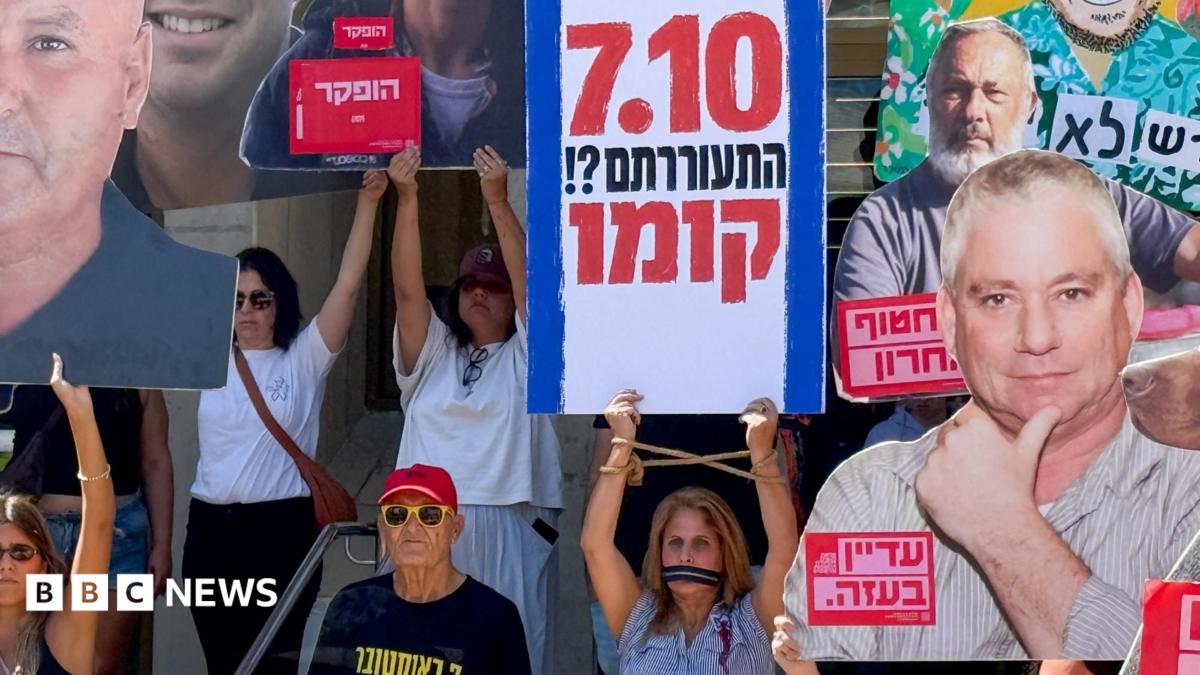
As dawn broke over southern Israel on Wednesday, residents of Kibbutz Kfar Aza walked in silence toward the community's armoury. The gathering marked three years since Hamas-led attackers stormed the kibbutz, killing members of its 14-person civil defence squad shortly after 7:00 a.m. on October 7, 2023. In total, 64 people from the community were killed that day and 19 were taken hostage into Gaza, losses that residents say remain raw and unresolved.
The anniversary has revived painful questions that many Israelis believe have never been properly answered. While Hamas bears responsibility for the assault itself, a growing number of citizens are demanding accountability from their own government over the intelligence and security failures that allowed the attack to unfold. Among them is Inbar Goldstein, who lost her brother and niece in the attack, while four other relatives were kidnapped from Kfar Aza. "I need my country to take responsibility," she said, describing what she called a long process of abandonment that neither began nor ended on October 7.
The assault was the deadliest single day Israel had experienced since the state's founding in 1948. Approximately 1,200 people were killed across southern Israel as gunmen breached the border fence and overran communities, while another 251 people were seized and taken back to Gaza as hostages. Three years later, no independent state inquiry has been established to examine how the failure occurred, a gap that critics say leaves the country vulnerable to repeating its mistakes.
At the centre of the accountability debate stands Prime Minister Benjamin Netanyahu, who was in office at the time of the attack and is now campaigning for re-election on a familiar promise: to be stronger and tougher than any rival in defending Israel from its enemies. Netanyahu has consistently rejected personal responsibility for the security breakdown, instead directing blame at his own security chiefs, whom he accuses of deliberately deciding not to wake him in the hours before the assault out of fear he would order a massive military deployment and escalate the situation.
In an interview with Israel's right-wing Channel 14 television network, Netanyahu suggested that had he been alerted, the outcome would have been different. He argued that his response would have better protected the country, asking what would have happened if officials had woken him. His comments have done little to quiet critics who contend that the prime minister is deflecting scrutiny away from political leadership and onto the military establishment.
Questions have intensified over what caused Israel's intelligence failure, what information reached military and political leaders in the run-up to the attacks, and what Netanyahu himself knew. For months beforehand, young female soldiers stationed at bases along the Gaza border to monitor suspicious activity had warned their superiors about possible preparations for an attack. Among them was Roni Eshel, who was killed along with 14 other members of her unit when gunmen overran their base at Nahal Oz, adjacent to Kfar Aza.
Her uncle, Elad Levy, said the family and the wider public deserve clarity. He raised a series of unanswered questions, including whether Egypt or the United Arab Emirates had warned the prime minister and whether other warnings were ignored. "We need to find out what happened – not just on the day, but the year before, and five years before that," he said, adding that if no inquiry takes place, the same failures will recur again and again.
Over the past three years, reports have mounted alleging that warnings were passed to Netanyahu by his own security chief as well as by regional neighbours, claims he denies. Last month, Israel's Haaretz newspaper published extracts from a new book alleging that the leader of the United Arab Emirates telephoned Netanyahu ten days before the attack to warn of Hamas plans for a major operation. Netanyahu's office dismissed the report as an absolute lie and said he would sue the newspaper.
Amir Ohana, a member of Netanyahu's Likud party, defended the prime minister in a social media video last month, calling it preposterous and absurd to suggest Netanyahu could have known about the attack when the former Hamas leader in Gaza, Yahya Sinwar, had shared the plans with only a handful of people. Ohana credited Netanyahu with reshaping the Middle East and said he did not give up even when voices inside and outside Israel urged him to stop.
For the families of Kfar Aza and other affected communities, however, the political arguments offer little comfort. The absence of a formal state inquiry means that key decisions, intelligence assessments and chains of command remain largely unexamined in a public forum. Relatives argue that without such a reckoning, the lessons needed to prevent future attacks will never be learned, and the trust between citizens and their leaders will remain broken.
The debate also carries broader implications for Israel's democracy and its military doctrine. A state inquiry could clarify how warnings from border observers were handled, whether political leaders were adequately briefed, and how decisions were made in the critical hours before the assault. It could also determine whether responsibility rests solely with the military or extends to the political echelon, a distinction with significant consequences as the country heads toward elections.
For now, the third anniversary has become both a memorial and a moment of reckoning. At Kfar Aza, candles were lit and mourners embraced as the community remembered those lost. But alongside the grief, there is a persistent demand: that the country confront the failures of October 7 openly, and that those responsible, at every level, be held to account. Whether that demand will be answered remains, three years on, an open and increasingly contentious question.






(0)