
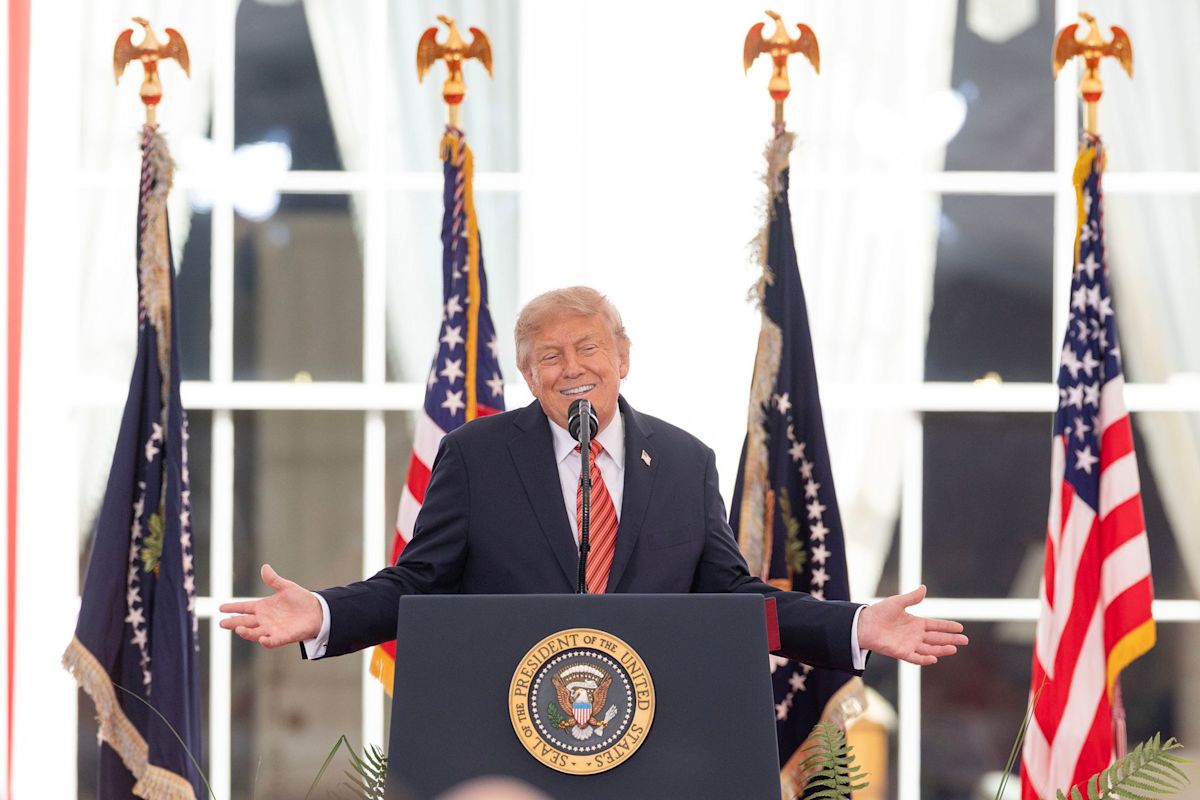
United States President Donald Trump pressed forward with the second day of his official visit to Ireland on Sunday, operating against the backdrop of an intensifying diplomatic row sparked by his outspoken endorsement of Irish unification during meetings with top domestic officials.
The political fallout was set in motion during an engagement between Trump and Irish Premier Micheál Martin. When questioned by a reporter from the Press Association regarding the long-standing constitutional division of the island, the American president explicitly voiced his desire to see a unified Ireland, remarking that he would love to see such an outcome and predicting that constitutional integration is inevitably bound to occur.
Trump spent the beginning of his Sunday at the Trump International golf links in Doonbeg, County Clare, situated along the country's south-western coastline. The luxury property is currently hosting the prestigious Amgen Irish Open, an event that has drawn world-class professional competitors, including prominent Irish golfers Rory McIlroy and Shane Lowry.
The US leader is slated to present the winner's trophy to the tournament champion at the close of the competition, marking one of his final engagements before concluding his two-day overseas itinerary and flying back across the Atlantic. Irish Premier Martin, along with several other high-ranking representatives from the Irish government, is likewise expected to be present for the final round of the golf championship in Clare.
While the president chose to spend Saturday evening observing the golfing action from an elevated balcony positioned over the 18th green, event coordinators and security personnel noted that he could take the opportunity to move directly across the fairways and traverse the course on Sunday.
An extensive, multi-agency security operation has been mobilized across the region to ensure the president's safety. Ireland's national police service, An Garda Síochána, has been working in close coordination with the Irish Defence Forces and the US Secret Service to maintain a tight security perimeter around the Doonbeg resort and surrounding districts.
The arrival of the American president triggered organized public demonstrations across multiple locations, including gatherings in Dublin and throughout County Clare. In response to the civic unrest, Garda Commissioner Justin Kelly issued a firm warning, emphasizing that security forces would maintain a zero-tolerance policy toward any instances of public disorder or deliberate attempts to interfere with the critical movements of the visiting head of state.
Trump's Irish trip commenced on Saturday morning when his aircraft—a newly acquired Air Force One gifted by Qatar—touched down at Dublin Airport. Upon arrival, he was greeted on the tarmac by Irish Deputy Premier Simon Harris before traveling to Áras an Uachtaráin in Dublin's Phoenix Park for an official audience with Irish President Catherine Connolly, who has previously established a reputation as a prominent critic of the US president.
The controversial remarks regarding a united Ireland prompted an immediate and sharp backlash from British political leaders across the Irish Sea. Conservative deputy leader Alex Burghart forcefully rejected Trump's assessment, calling the American president very wrong and reiterating that Northern Ireland remains an integral and inseparable component of the United Kingdom.
Officials in the British government similarly responded by drawing attention to recent policy pronouncements by UK Prime Minister Andy Burnham. Addressing lawmakers earlier in the week, Burnham underscored that any prospect of holding a border poll would only be considered when a clear and decisive consensus emerges across the country, having previously caused controversy earlier in the year by declaring such a referendum off the table.
The friction surrounding the Irish border has added to broader diplomatic strains between Washington and London. Those relations were further tested during the trip after Trump made provocative observations questioning the United Kingdom's military capacity to defend the Falkland Islands in the event of a potential international conflict.
The controversy has also highlighted shifting dynamics among political parties within Northern Ireland itself. Rejecting Trump's perspective, Democratic Unionist Party (DUP) leader Gavin Robinson stated firmly that the constitutional future of Northern Ireland must be decided solely by its own populace, rather than guided by external commentary emanating from London, Dublin, or Washington. Robinson reinforced his party's stance by declaring that unionists have no interest in dismantling their country to merge with the Republic of Ireland.
In sharp contrast, Irish republican leaders welcomed the president's intervention. Sinn Féin leader Mary Lou McDonald described Trump's remarks as timely and constructive, arguing that the statement should serve as a clear directive for Premier Martin and the Irish government to immediately initiate comprehensive planning for future Irish unity.
These competing reactions illustrate the nuanced relationship Washington maintains with rival Northern Irish factions. While Sinn Féin has actively boycotted the traditional St. Patrick's Day delegations to the White House over disagreements regarding Trump's foreign policy in the Middle East, main unionist organizations, including both the DUP and the Ulster Unionist Party (UUP), have continued to engage diplomatically with the president.
The constitutional mechanism governing any potential realignment of Northern Ireland is formally anchored in the 1998 Belfast/Good Friday Agreement. Under the legal terms of the landmark treaty, the UK's Northern Ireland Secretary holds the statutory power to call a border poll and is bound by a duty to do so if public polling indicates that a majority of voters would likely favor unification, an outcome that would also require parallel approval through a referendum held in the Republic of Ireland.





(0)