
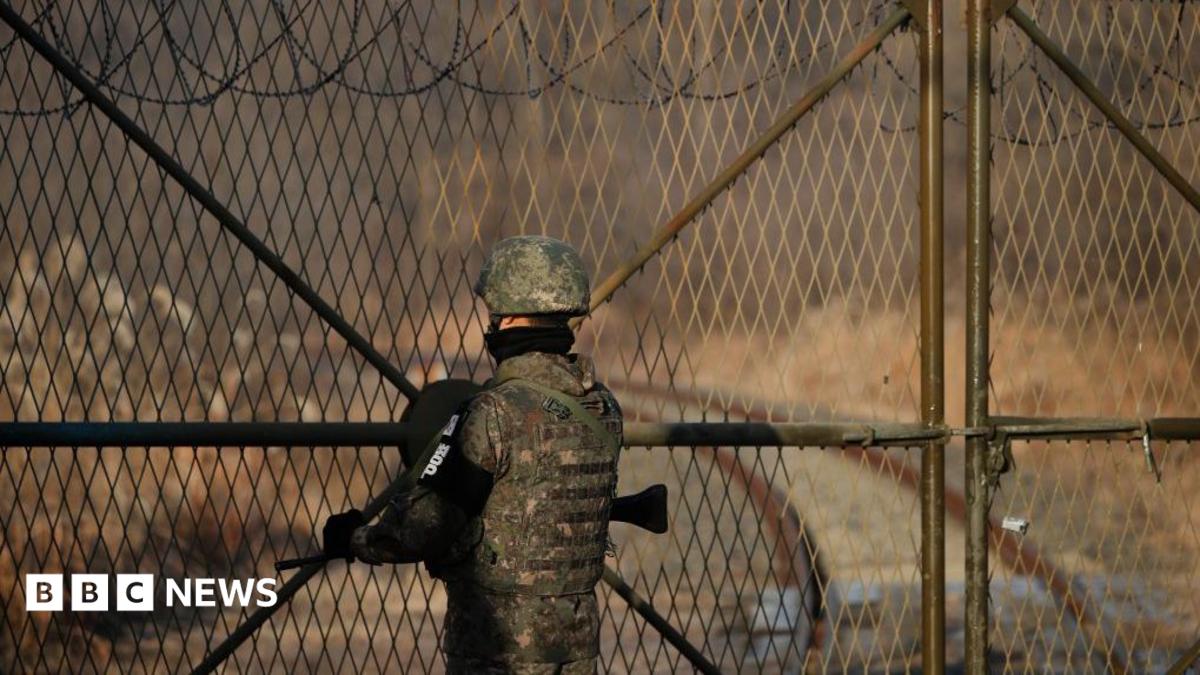
South Korea's military has publicly called on North Korea to issue a formal apology for landmine explosions inside the Demilitarised Zone that left three South Korean personnel wounded earlier this month, sharply escalating a war of words between the two Koreas over the incident.
The explosions occurred on 21 September on South Korea's side of the DMZ, the heavily fortified buffer strip that has separated the two nations since the Korean War ended in an armistice rather than a peace treaty. According to Seoul's military, the blasts are "highly likely" to have been caused by North Korean mines, a conclusion that prompted the South to vow "corresponding measures" against what it describes as a violation of the decades-old ceasefire agreement.
In a statement issued on Wednesday, South Korea's military went further, urging Pyongyang to apologise for the blasts and to immediately halt any fortification activities along the shared border. Seoul believes the mines were planted by North Korean forces as part of efforts to reinforce their side of the frontier, a practice that South Korean officials argue contravenes the terms of the 1953 armistice.
Defence Minister Kang Shin-chul said on Tuesday that the explosions represented a "clear" violation of that armistice, the agreement that halted active combat in the Korean War and established the Demilitarised Zone. The DMZ, roughly 4km (2.5 miles) wide, contains the Military Demarcation Line, which serves as the de facto land border between North and South Korea and remains one of the most heavily militarised frontiers in the world.
North Korea has flatly rejected responsibility for the blasts. Pyongyang dismissed Seoul's claims as "groundless" and characterised them as a "farce" designed to inflame tensions on the Korean Peninsula. The denial was amplified by Kim Yo Jong, the influential sister of North Korean leader Kim Jong Un, who accused South Korea of fabricating the allegations to serve what she described as political and military provocation.
Kim specifically rejected suggestions that North Korean personnel had crossed the border to plant the mines, calling the accusation "a deliberate and planned strained assertion to shift the responsibility for escalating tension" onto Pyongyang. Her statement, carried by state media on Wednesday, also included a pointed warning that the South should be "prepared for paying price for the farce of their own making" — language that signals Pyongyang has no intention of de-escalating the dispute in the near term.
The exchange marks the latest flashpoint in a long history of sporadic clashes and mine incidents inside the DMZ. In 2015, two South Korean soldiers were maimed by landmines while patrolling the area. At the time, Seoul said the devices had been secretly planted by North Korean soldiers near a South Korean guard post, a claim Pyongyang also denied. Kim referenced that episode in her statement this week, arguing that South Korea had used the 2015 incident as a "pretext" to escalate tensions and was now repeating the same playbook.
The United Nations Command, which conducted on-site investigations into the recent blasts alongside the South Korean military, has said it will address the alleged armistice violation "through established Armistice mechanisms." In a statement, the UNC emphasised that it "remains committed to maintaining and enforcing the Armistice Agreement and fulfilling its responsibilities to preserve stability and prevent escalation on the Korean Peninsula." The command's involvement underscores the international dimension of the dispute, given its role as the enforcing body of the 1953 agreement.
The timing of the incident adds to its sensitivity. Relations between the two Koreas have remained deeply strained, with diplomatic engagement largely stalled and military tensions persisting along the border. Any incident inside the DMZ carries the risk of triggering a broader confrontation, particularly when both sides publicly harden their positions and trade accusations through state media and official statements.
For Seoul, the demand for an apology serves multiple purposes. It signals to domestic audiences that the government is responding firmly to a security threat against its troops, while also reinforcing its position that North Korea is the party responsible for violating the armistice. The pledge to take "corresponding measures" leaves open the possibility of a military or diplomatic response, though South Korean officials have not specified what those measures might entail.
Pyongyang's rejection, meanwhile, follows a familiar pattern of denying responsibility while casting South Korean claims as politically motivated. By framing the allegations as a fabrication intended to provoke, North Korea positions itself as the wronged party and reserves the right to retaliate, a stance that Kim Yo Jong's warning language makes explicit.
The role of the United Nations Command could prove pivotal in the coming weeks. As the body responsible for overseeing the armistice, the UNC's findings and any subsequent action through established mechanisms will shape how the dispute unfolds. Its public commitment to preventing escalation suggests it will seek to manage the situation through existing channels rather than allowing it to spiral into a wider confrontation.
Despite the heated rhetoric, neither side has indicated a willingness to back down. South Korea continues to demand accountability and a halt to border fortification, while North Korea insists the accusations are baseless and warns of consequences. With the DMZ remaining a flashpoint and historical grievances still unresolved, the landmine blasts of 21 September have reignited a dispute that carries implications well beyond the three soldiers who were injured.








(0)