
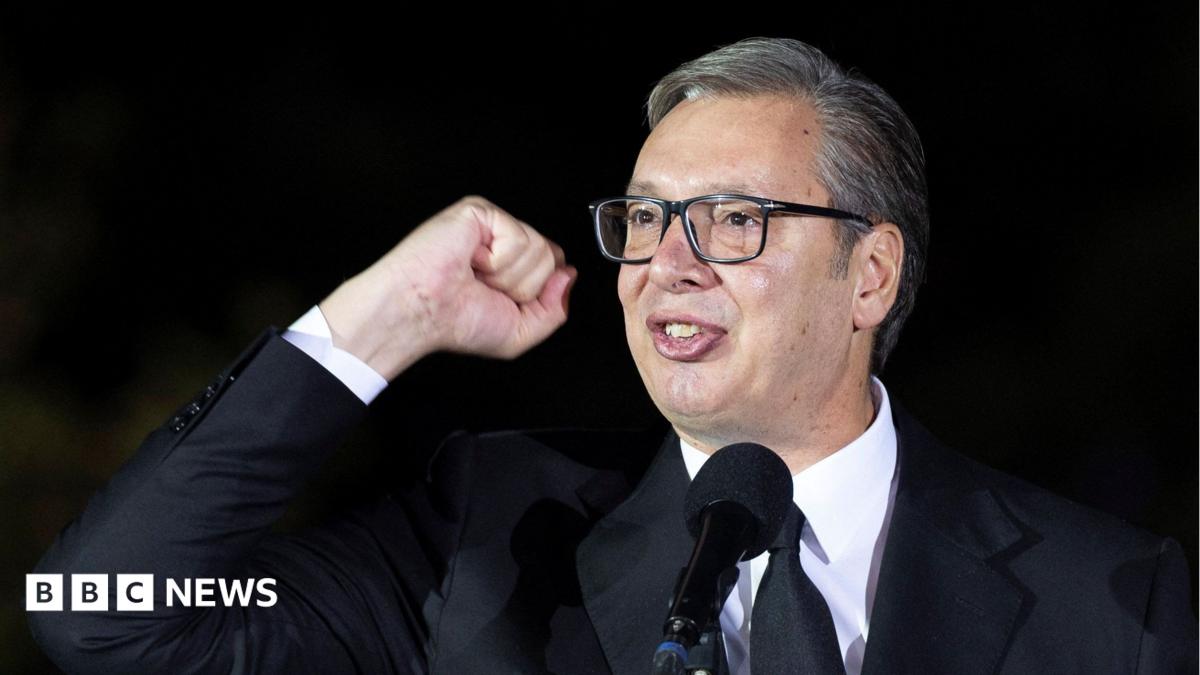
Serbia's President Aleksandar Vučić has stepped down, ending a presidency that spanned nearly a decade and was increasingly overshadowed by public anger over allegations of government corruption. The resignation, announced in an address to supporters gathered outside the presidential building in Belgrade, marks a significant turning point for a country where Vučić has been the dominant political figure for more than ten years.
In his remarks, Vučić framed his tenure as a period in which his administration had safeguarded peace and stability. Yet the resignation follows more than a year of sustained, student-led demonstrations that grew into one of the most serious challenges to his authority since he first entered government. What began as outrage over a deadly infrastructure failure evolved into a broad movement demanding accountability and systemic change.
Vučić had signalled his intention to resign as early as June, meaning the decision was not entirely unexpected. He is now campaigning to become his party's candidate for prime minister in the forthcoming parliamentary elections. Serbia's constitution prevents him from seeking a third presidential term, so the move to the prime ministerial race offers a route to remain at the centre of national politics.
The unrest that ultimately forced his hand can be traced to November 2024, when the roof of the railway station in Novi Sad collapsed, killing 16 people. The tragedy struck a deep nerve across Serbian society. The station's renovation had been a flagship infrastructure project, heavily associated with Vučić himself and promoted as evidence of the country's modernization and progress. Instead, the disaster became a symbol of what critics described as years of corner-cutting and mismanagement.
In the aftermath, protests spread rapidly, drawing together an unusually wide cross-section of society. Students and teachers marched alongside factory workers, farmers, and urban professionals. The breadth of the movement signalled that discontent had moved well beyond the usual political opposition, touching citizens who had not previously taken part in demonstrations. Many participants said the collapse confirmed long-held suspicions that public safety had been sacrificed to speed and political image-making.
A wave of resignations by officials failed to calm the streets. If anything, the concessions appeared to embolden protesters, who argued that individual departures did not address the deeper problems they wanted tackled. Demonstrations continued through the summer, and tensions escalated after accusations of police brutality emerged. In August, protesters set fire to offices belonging to the ruling Serbian Progressive Party, underscoring how far the situation had deteriorated.
Vučić's presidency had been due to expire next year, but his early departure triggers a constitutional requirement that a presidential election be held within three months. As a result, Serbians are now expected to go to the polls twice before the end of the year. A snap parliamentary election has been scheduled for late October, a vote that was itself called in response to the protest movement's demands. The presidential contest will follow more than a month later.
Until a new president is elected, parliamentary speaker Ana Brnabić, who is also a member of the Progressive Party, will serve as interim president. The arrangement ensures continuity of the office, though it also keeps the ruling party in control of the presidency during the transition, a detail likely to be scrutinized by opposition groups and protesters alike.
In one of his final acts before leaving office, Vučić used his constitutional powers to pardon 49 people. According to the Serbian public broadcaster RTS, those pardoned included 23 students and several party loyalists suspected of offences connected to what he described as the "terrible events we have gone through over the past year and a half." The pardons are likely to provoke further debate about accountability, particularly given the tensions surrounding the policing of protests.
The parliamentary elections will set Vučić's Progressive Party against a student-led anti-corruption movement known as Students Win, as well as a coalition of pro-Western opposition parties operating under the banner European Serbia. The contest will effectively serve as a referendum on more than a decade of Progressive Party rule and on whether the protest movement can translate street momentum into institutional power.
Vučić has been a fixture of Serbian politics since becoming prime minister in 2014, before winning his first presidential term in 2017. Throughout his time in office, he has pursued a foreign policy that balances competing interests. He has publicly committed to Serbia's eventual membership in the European Union while simultaneously cultivating close ties with Russia and welcoming Chinese investment. That balancing act has drawn both praise for pragmatism and criticism for ambiguity, particularly as the EU has pressured Belgrade to align more closely with its positions.
For the protest movement, the resignation represents a hard-won victory but not an endpoint. Demonstrators have consistently framed their demands around transparency, accountability, and the rule of law rather than simply the removal of one figure. Whether those demands can be satisfied through elections remains uncertain, especially with Vučić seeking to remain in power as prime minister and his party still commanding significant institutional resources.
The coming months are likely to be defined by intense campaigning, questions about the fairness and conduct of the votes, and continued scrutiny of the Novi Sad disaster. International observers will be watching closely, given Serbia's role in the Balkans and its delicate position between the EU and Russia. For many Serbian citizens, the double election represents both an opportunity and a test of whether a political system long shaped by one man can genuinely change course.



(0)