
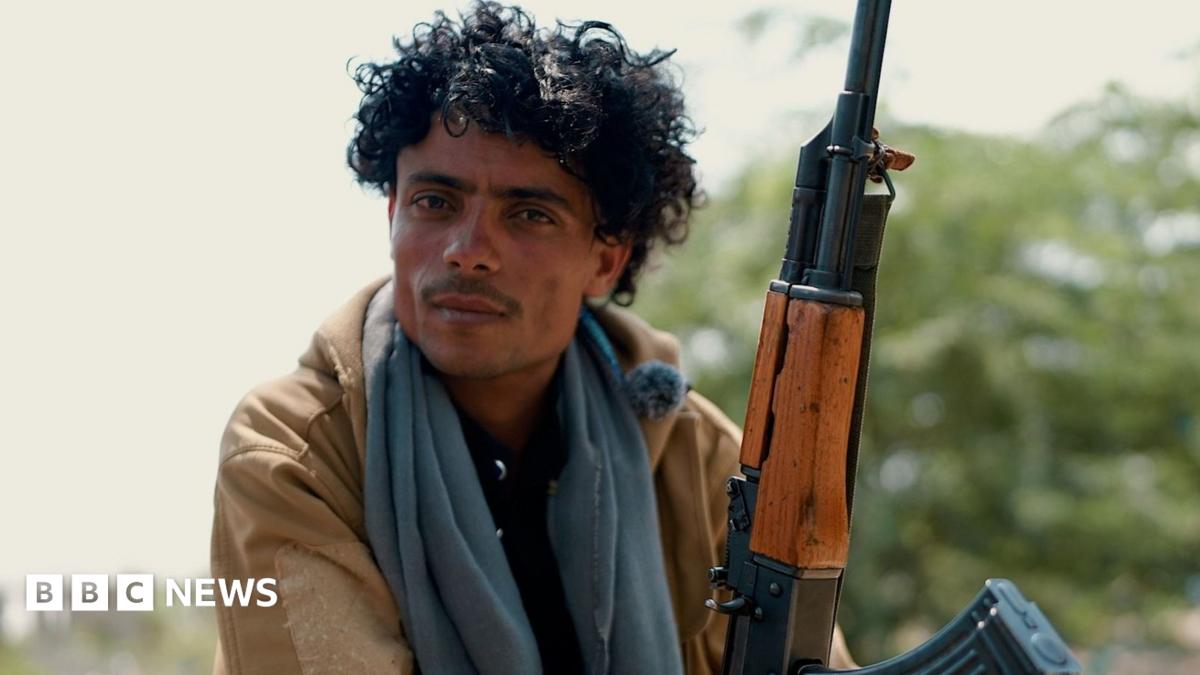
TAIZ, YEMEN — The front line in Yemen's south-west is not a trench or a fence. It is a shifting boundary in steep mountain terrain, marked less by fortifications than by silence: the abandoned houses of families who fled, the empty roads, and the sudden appearance of soldiers dug into high ground above the city. It was here, among the slopes south-west of Taiz, that a BBC team travelled with Saudi-backed government forces to see what months of renewed fighting look like at close quarters.
The dangers announced themselves almost immediately. A soldier escorting the team pointed upwards and said it was the first drone, noting that it was usually followed by an attack. The buzzing overhead grew louder as the group took shelter under bushes, then climbed back into the vehicle and drove on. Within roughly ten minutes, the report came, heavy thuds of explosions followed one after another, though it was impossible to tell from the hiding place exactly where the strikes had fallen.
Mountainsides around the city are dotted with homes, many of them now empty. Residents who remained described a landscape transformed by months of artillery and gunfire: the constant flow of cars and motorbikes that once filled the streets has thinned to almost nothing, leaving behind the bleating of livestock and the crack of incoming and outgoing fire. It is a city that appears, from a distance, to be going about its business while under siege.
One man who refused to leave is Ali, who sat outside his home with a herd of goats about a kilometre from the front line. He said two mortars had landed on his property. He had sent his children to a displacement camp, he said, because the shelling and gunfire had become unbearable for them, but he stayed behind with his wife and sisters to care for the animals. Asked about his safety, he was blunt about the calculation behind his decision: he is terrified, he said, but the family would go hungry without the animals and starve anyway. He gave only his first name, clearly worried about reprisals should the Houthis take the area in the coming days.
That anxiety is not misplaced, according to the picture the reporting team was given from both sides. Contacts on the Houthi side said their forces were consolidating troops and preparing for a major offensive. Government forces, when asked, said they were aware of the threat and were preparing as well. Neither claim could be independently verified on the ground, but the tempo of the reporting — drones arriving minutes before strikes, checkpoints multiplied on the roads leading in, fighters returning exhausted from positions just a few hundred metres from advancing Houthi lines — is consistent with forces on both sides bracing for the next round.
At the checkpoint closest to the fighting, the team met government fighters who had just come down from positions high on the mountain, within a few hundred metres of Houthi fighters. One of them described the position as almost hopeless: he said the bodies of 18 government soldiers lay in an area his unit could fire across but could not reach. The dead, he said, were being shot over — the line had moved beyond any possibility of recovery.
The intensification of the battle around Taiz follows directly from the collapse of the country's long-standing ceasefire. On 10 September, Houthi forces seized the strategic Red Sea port of Mokha, 85km to the west of the city, ending a period of relative calm that had held for roughly four years. The port sits on a stretch of coast overlooking the Bab al-Mandab Strait, the narrow waterway that serves as a crucial shipping corridor linking Europe and Asia. With the Houthis holding high ground above the strait, the risk of disruption to regional trade routes became a global concern, and oil prices rose as fears grew that supplies from the area could be hit.
For the Yemeni combatants, the strategic stakes are more immediate. If the Houthis consolidate their hold on the terrain overlooking the coast, government forces face a far harder task in retaking Mokha. Control of the high ground west of Taiz has therefore become a priority rather than a formality — and the fiercest recent fighting has unfolded precisely on those western approaches, where both sides contest ridges overlooking the city's route south.
Taiz itself is Yemen's third largest city and its cultural capital, home to close to a million people. Its position is unusually awkward: it sits at a vital intersection between Houthi-controlled territory in northern Yemen and government-held areas in the south, and is hemmed in by front lines on several sides. Government forces hold the centre, while Houthi positions lie to the north and east, leaving the western approaches as the decisive flank.
The journey to the city from Aden, where Yemen's internationally recognised Presidential Leadership Council and government are based, revealed something about the forces on the government side that no map shows. The route passed roughly 30 checkpoints, each marking a stretch of road under the control of a different commander — a clear sign of how fractured the government coalition is compared with the Houthi movement's unified command. Control of territory on the ground is negotiated, local and constantly shifting.
Signs of the human cost grew more frequent as the team approached the city. Ambulances began to pass them on the road, and at least five were counted within half an hour, all heading towards Taiz's main hospital. It was, the reporting team said, a clear indication of driving into a city at the heart of a brutal battle.
Arrival came after dark, and the contrast was striking. Shops were lit, restaurants were packed, and children were playing in the streets. But every so often, other sounds cut through the noise of ordinary life — the thud of shelling and the crack of gunfire from the mountains surrounding the city.
That duality is Taiz's defining condition. On one side of the ridge, a functioning city of nearly a million people goes to work, eats and queues for food; on the other, mortars fall on farm plots and soldiers lie where they fell, out of reach of their own comrades. The seizure of Mokha and the battle for the high ground west of Taiz suggest a phase of the war reopening rather than concluding — and it is in the gap between the lit restaurants and the incoming fire that the cost of that escalation is most visible.






(0)