
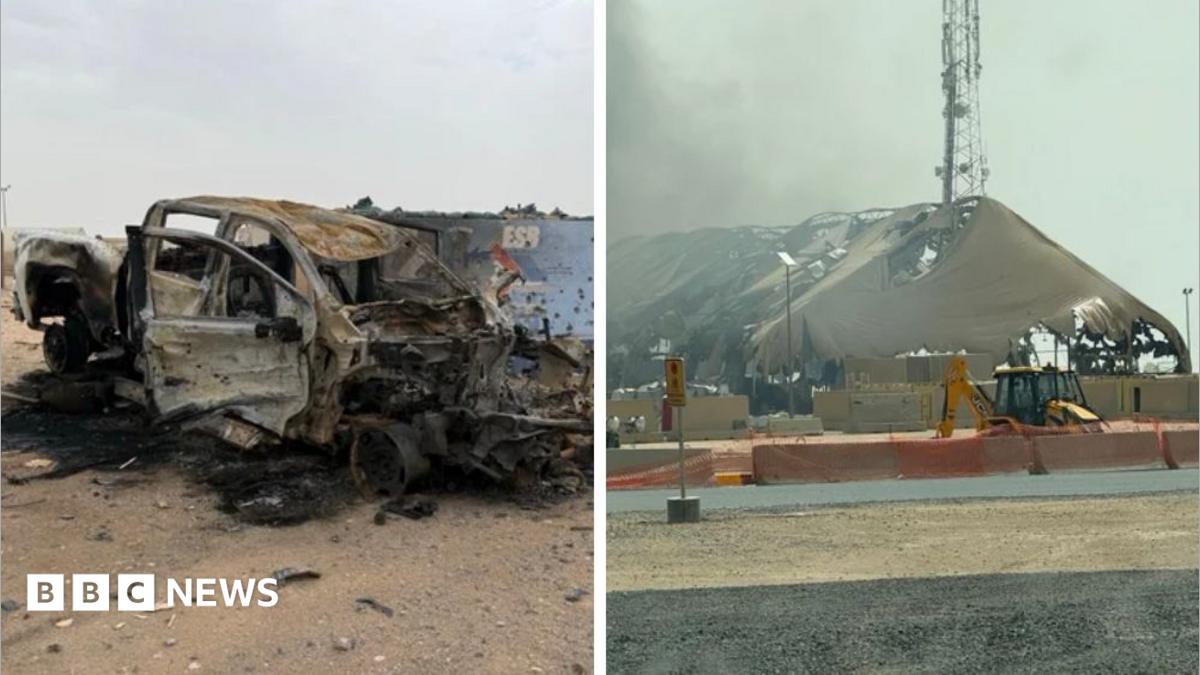
Recently disclosed photographs have provided an unvarnished look at the severe physical damage inflicted on several United States military installations in the Middle East as a result of Iranian strikes. The visual materials, which offer a rare glimpse into the vulnerability of American strategic outposts in the Gulf region, show flattened support facilities, heavily damaged multistory infrastructure, and high-value military aircraft torn apart by munitions.
The undated collection of photographs was provided by active-duty military personnel to CBS News, a US media partner of the BBC. According to the reporting, the images document the destructive aftermath at key American operating locations situated across Saudi Arabia and Kuwait, highlighting the severe operational disruptions caused by Iranian missile and drone barrages.
The release of the images has underscored a significant gap between official public disclosures and the realities faced by deployed service members on the ground. One anonymous military service member expressed sharp frustration over how the situation has been handled, telling CBS that the extensive destruction visited upon US bases has not been adequately shared with the American public. The service member described the defenselessness felt by troops as akin to standing with closed eyes while taking direct blows.
Official government responses to the publication of the imagery remain sparse. Inquiries directed toward the White House resulted in the administration referring questions to United States Central Command, which oversees American military operations throughout the region. However, Centcom did not immediately supply a response to requests seeking formal comment on the leaked files.
Among the most striking visuals in the newly released batch is a photograph documenting the total destruction of a Boeing E-3 Sentry aircraft stationed at Prince Sultan Air Base in Saudi Arabia, an installation situated roughly 62 miles (100 kilometers) southeast of Riyadh. The surveillance aircraft was completely severed in half by the blast, leaving its mangled rear fuselage and tail section reduced to a heap of twisted metal wreckage on the tarmac.
The Boeing E-3 Airborne Warning and Control System (AWACS) represents an essential asset for coalition defenses, operating specialized long-range radar designed to spot and track approaching threats from vast distances to provide advance warning. While this specific photograph remained undated, prior investigative reporting by BBC Verify had identified and confirmed a matching image of the same radar plane taken in March. At the time of that strike, a US official reported to Reuters that 12 American service members were injured, two of them critically, during an Iranian assault on the Saudi air base.
Additional photographic evidence highlights widespread devastation at installations across the border in Kuwait. A pair of undated photographs taken at Camp Buehring shows support infrastructure reduced to rubble, including completely crushed trailers and a vast tented structure torn into shreds while heavy plumes of smoke drift above the compound.
Another image from Kuwait captured a damaged four-story building located at Camp Arifjan. The base had previously suffered damage during an attack in March, which affected satellite communications hardware on site, although it has not been formally confirmed whether this particular building photograph originates from that same military strike.
The circulation of the leaked photos closely follows the public release of a comprehensive report from the Pentagon’s official watchdog. That oversight assessment confirmed that Iranian attacks have managed to damage or destroy hundreds of structures and military buildings across an expansive network of American operating bases in Kuwait, Bahrain, Qatar, the United Arab Emirates, Saudi Arabia, Iraq, Oman, and Jordan over the course of the hostilities.
The Pentagon watchdog’s assessment laid bare the staggering financial consequences of the ongoing conflict, calculating that equipment losses alone have reached roughly $3.7 billion (£2.8 billion). When factoring in total combat and operational expenditures through June 29, the United States has spent approximately $33.4 billion (£24.7 billion) managing the wider military campaign.
The document further confirmed that US aviation assets suffered significant attrition in the initial months following the outbreak of hostilities, with dozens of aircraft being either heavily damaged or entirely destroyed. Among the specific losses detailed in the report were five crucial aerial refueling tankers that were caught on the ground in Saudi Arabia and struck by Iranian munitions.
Parallel research conducted by the Congressional Budget Office (CBO) underscored the immense difficulty and expense of replacing key hardware lost in the theater. The CBO noted that because the E-3 Sentry is out of production, the military must transition to the more modern E-7 platform at a cost of roughly $500 million (£371 million) per aircraft. Overall, the CBO estimated that destroyed combat assets—encompassing aircraft, uncrewed drones, and a Terminal High Altitude Area Defense (THAAD) system—totaled $1.9 billion (£1.4 billion).
The CBO pointed out that its financial and asset evaluations faced notable uncertainty because the Department of Defense declined to answer its formal inquiries, forcing analysts to rely exclusively on public records and government databases. Consequently, the exact scope and timeline of the Pentagon's planned repairs and base reconstruction efforts remain fundamentally unclear.
The visual evidence and oversight reports have drawn sharp criticism from national security experts regarding the state of American readiness. Brian Katulis, a former national security official who served across both Democratic and Republican administrations and currently works as a senior fellow at the Middle East Institute, argued that the visible destruction demonstrates that the US failed to adequately prepare its base defenses in advance.
Katulis also contended that the Trump administration failed to take necessary measures to fix known operational vulnerabilities while rapidly expending high-value military assets. Furthermore, he highlighted strong indications that adversarial foreign powers, specifically Russia and China, may have provided critical targeting support to assist Iran in pinpointing vulnerable American assets across the Middle East.







(0)