
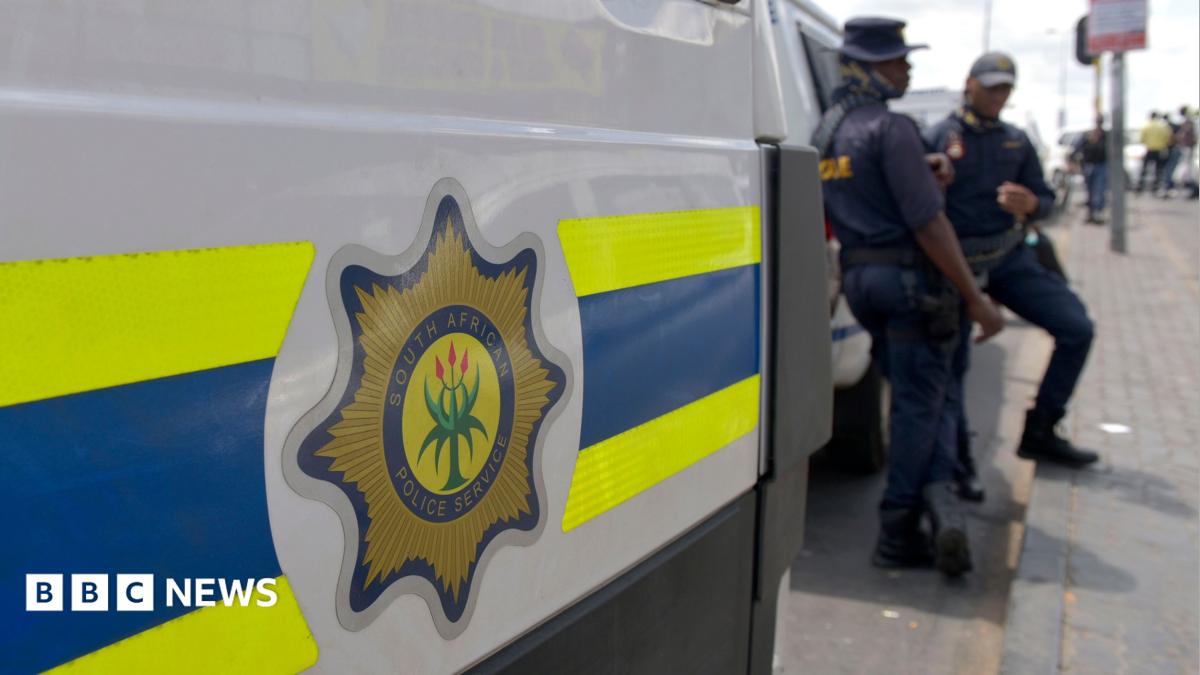
Police in South Africa have recovered the body of a tenth woman in a Johannesburg suburb, in a case that has become a focal point of national anger over the scale of violence against women in the country.
The body was discovered on Saturday morning at a cemetery in Tembisa, a neighbourhood north-east of central Johannesburg, according to the South African Police Service. The woman was identified after a friend who had been with her at a bar the previous evening was shown a picture of the remains and recognised her friend's clothing.
Speaking to reporters, Gauteng Police Commissioner Tommy Mthombeni said detectives had noted similarities across the 10 deaths in the Ekurhuleni municipality, which includes Tembisa, as well as a further killing in Soweto. He said the pattern meant investigators could not rule out a serial killer, but equally could not assert one.
"For now, it's not something which we can overrule to say there's a serial killer, but we cannot conclusively indicate as such," the lieutenant general said. He added that at such an early stage it was too soon to say whether the latest death was linked to the others.
The commissioner said the other bodies shared a "similar victimology" — the study of how victims are selected and targeted — indicating a shared "modus operandi" of killing. Those characteristics would allow detectives to determine whether the newest case continues the same series.
Police said crime scene investigators were at the cemetery gathering evidence shortly after the body was found. Officials have not publicly identified the victim.
The friend who identified her body spoke to the national broadcaster SABC, describing the moment she was shown the photograph. "I don't know what I'm going to say to her children," she said, wiping away tears. "It's painful."
Ten of the bodies have been recovered since July in broadly similar circumstances. Most were found in Kempton Park, the neighbouring suburb, and many of the victims were young women. Almost all had suffered extreme violence before their deaths, the BBC reports.
The killings have placed fresh pressure on the national government, less than a year after ministers declared gender-based violence and femicide a national disaster — a designation that unlocks additional resources and coordination for policing and support services, but which critics say has not slowed the killing.
The wider context is a country with one of the highest homicide rates in the world. Police recorded 5,427 murders between April and June this year alone. Official police statistics do not break victims down by gender, a gap that campaigners and rights groups have repeatedly criticised because it obscures the scale of violence against women specifically.
Last week the South African Human Rights Commission reported that 569 women were killed and a further 1,052 survived attempted murder in the same April-to-June period — figures that illustrate why women's groups have pressed for gender-disaggregated data and for gender-based violence to be treated as a distinct crime category rather than subsumed into general homicide figures.
Three men appeared in court earlier this week accused of involvement in one of the nine earlier murders, with police working to track down others who may have been involved. No suspect has yet been charged in connection with the latest death, and prosecutors have not linked any arrests to the wider series.
The discovery has intensified a public reckoning that has already been building for months. Families and women's rights organisations have described a growing sense of dread in communities north-east of Johannesburg, where families say the normalisation of the killings has eroded confidence in the police response.
Analysts have cautioned that patterns visible to the public are not the same as proof, and that premature labelling of a series as the work of a single serial offender can misdirect an investigation. Serial killing, by definition, requires evidence that one person is responsible for multiple deaths; where links between victims are assumed rather than demonstrated, the risk is that a number of unrelated cases are merged into one narrative and resources are spread thinly.
At the same time, investigators have said the similarities between cases are more than coincidence: a consistent victim profile and method across a series of killings, in the same small number of adjacent neighbourhoods, is precisely the kind of pattern that warrants a dedicated task force.
Commissioners have repeatedly said forensic and digital evidence gathered at each scene is the key to establishing whether the cases are connected, and have appealed for witnesses to come forward. Progress, they suggest, depends on identifying links between the victims — their social circles, their movements on the nights before their deaths, and whether any suspect is known to more than one family.
The case has also drawn attention to the policing of gender-based violence more broadly, with researchers noting that South Africa's murder statistics, while voluminous, often obscure the fact that a disproportionate number of victims are women killed by people they know.
For now, the investigation continues in Tembisa, with the identity of the woman due to be confirmed officially in due course. The questions she leaves behind — who she was, where she worked, who else was with her that night — are the same ones being asked of the nine women found before her.






(0)