
When masked men walked into a half-empty restaurant in Yekaterinburg and surrounded him, Evan Gershkovich understood immediately that his life was about to change in ways he could not yet fully grasp. The American journalist, then working as the Wall Street Journal's Moscow correspondent, had been meeting someone he believed was a source for a story. Instead, he later concluded, he had been deliberately lured into a trap designed to turn him into a geopolitical bargaining chip.
In an interview with BBC Radio 4's Today programme, Gershkovich recounted the events of that day in 2023 with striking clarity. He described how roughly six masked men entered the dining hall and uttered a phrase that struck him as peculiar at the time: "I think we booked that table." On reflection, he recognized the calculated nature of the words, explaining that such a statement serves to freeze a person in place, preventing any instinctive reaction or attempt to flee.
The two men at the table stood up, and Gershkovich was informed he was under arrest by the FSB, Russia's powerful domestic security service. That was the instant, he said, when the gravity of the situation became undeniable. The involvement of the FSB signaled to him that everything had been planned in advance. The man he had been meeting vanished into the crowd, leaving Gershkovich to face the consequences alone.
What followed was a period of 16 months in Russian custody, during which Gershkovich was held in Moscow's notorious Lefortovo jail. The facility has a long and dark history, having housed high-profile political prisoners and dissidents over the decades, including during Joseph Stalin's Great Terror in the 1930s, when torture and execution were routine. Gershkovich described his confinement as deeply isolating, spent in a tiny space that wore on him psychologically. Yet he also acknowledged that he was treated relatively well, allowed to sleep and given adequate food.
The espionage charges against him were always maintained to be false by both Gershkovich and his employer. He was ultimately sentenced to 16 years in prison, a punishment that many observers viewed as politically motivated from the outset. Gershkovich himself said he quickly came to understand that the case against him was fabricated, designed not to punish a genuine spy but to create a valuable hostage.
That realization, paradoxically, brought him a sense of relief. He noted that he was neither interrogated nor tortured, tactics commonly employed by Russian security services against people accused of espionage. The absence of such treatment told him he was being treated more like a commodity than a true enemy of the state. In his words, he recognized that Moscow had set him up to serve as a pawn in a larger game, which meant his ordeal would likely last a long time but would not stretch to the full 12 to 20 years some might fear.
This understanding helped him remain stable and disciplined during his imprisonment, but it also gave him a framework for predicting what might come next. He anticipated that his case would generate significant international attention, and he was correct. Media organizations around the world reported extensively on his detention, his face appeared on a billboard in Times Square, and then-US President Joe Biden publicly stated that securing Gershkovich's release was among his highest priorities.
Gershkovich believed this global outcry was itself part of Moscow's strategy. By holding a high-profile American journalist, Russia positioned itself to exchange him for one of its own operatives. That operative turned out to be Vadim Krasikov, an assassin serving a life sentence in Germany. Gershkovich observed that Moscow effectively got away with the maneuver without facing sanctions, a calculated play that he described as smart when viewed cynically.
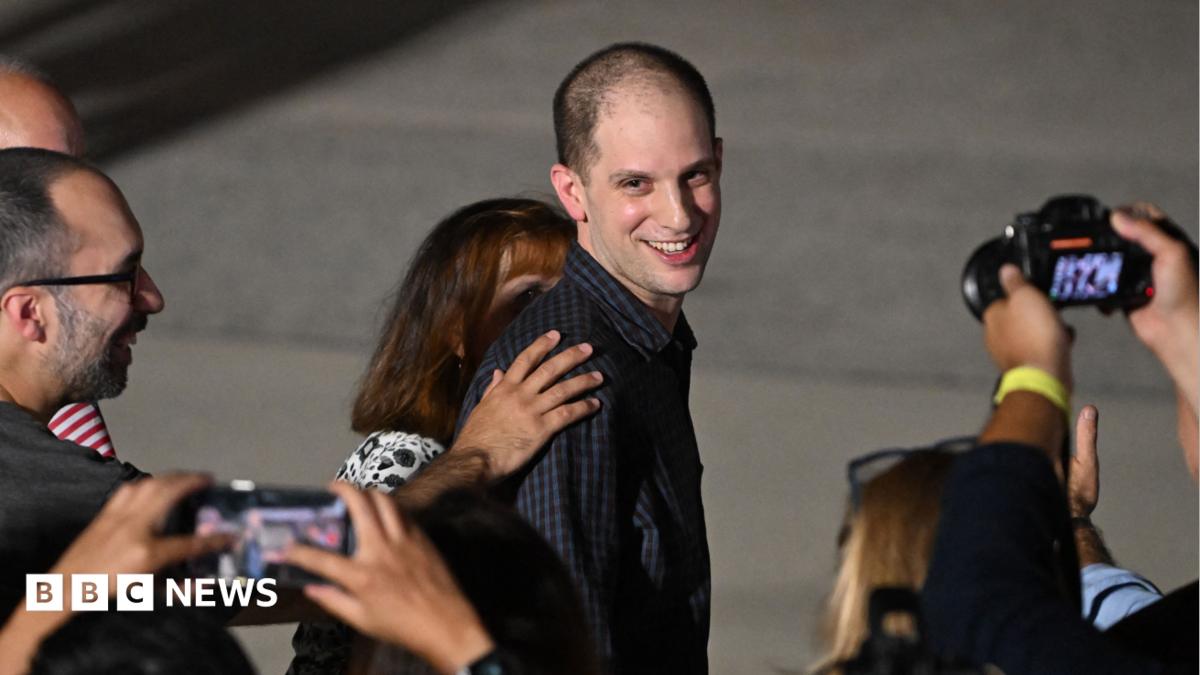
During his court appearances in Moscow, Gershkovich made a deliberate choice to smile at the cameras. Photographs of him appearing calm and defiant were broadcast around the world, and he said this was intentional. He wanted to demonstrate that he was alright and to deny Moscow the satisfaction of controlling the narrative. If the proceedings were a form of theater, he reasoned, there was no reason to let the authorities dictate how the performance unfolded.
At the same time, Gershkovich was careful to distinguish his experience from that of others held in Russian custody. He noted that some prisoners are tortured, broken as human beings, deprived of food and hot water, and told they will never see their families again. He emphasized that his treatment was completely different. As a point of comparison, he referenced Ukrainian journalist Viktoriia Roshchyna, who died in Russian captivity in 2024 at the age of 27. When her body was eventually returned months later, reports indicated signs of torture and that her organs had been removed.
Gershkovich learned three weeks before his release that a prisoner swap was in the works. He described that waiting period as excruciating, with each day feeling painfully long. The exchange finally took place on 1 August 2024, and he recalled it as a moment of pure joy. Yet that joy soon faded as the adrenaline subsided, and he was confronted with the challenge of returning to normal life. He admitted that this transition was difficult and at times overwhelming.
Now 34 years old and based in Berlin, Gershkovich has had time to reflect on his ordeal from a distance. He had lived in Russia since 2017, building a career as a foreign correspondent in one of the world's most politically volatile environments. His arrest and subsequent release have made him a symbol of the risks journalists face in countries where press freedom is increasingly constrained. His account serves as a reminder that behind every prisoner swap and diplomatic negotiation are individuals whose lives are upended by forces far beyond their control.




(0)