
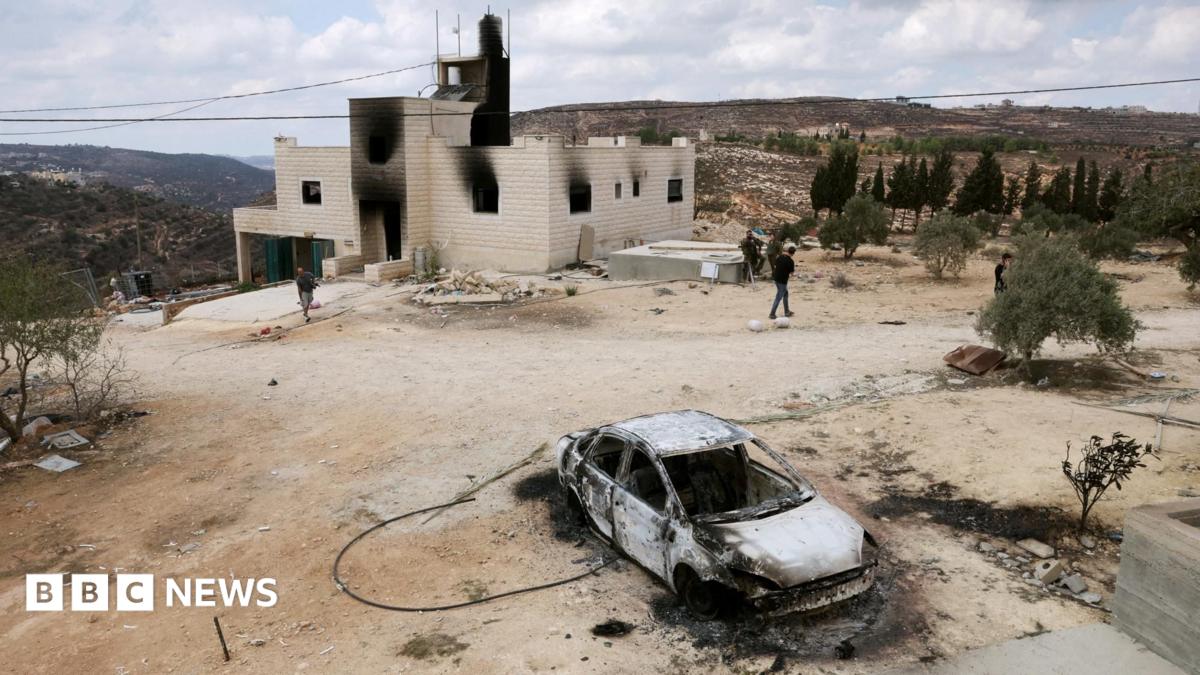
More than 100 Israeli settlers descended on a Palestinian village in the occupied West Bank on Monday night, setting fire to two family homes and preventing a court-ordered return that had been mandated by Israel's highest judicial body. The violent raid in Jalud, located south of Nablus, has renewed concerns about the Israeli government's inability or unwillingness to curb settler violence against Palestinian communities.
The al-Tubasi family had been attempting to reclaim their properties under the protection of Israeli security forces when the attack unfolded. Mahmoud al-Tubasi, 60, along with his wife Aida, 51, and their 33-year-old son Wael, had been escorted by the Israeli military after the High Court ruled earlier this month that they must be permitted to return to their homes. The court's decision came after the family was forced to flee the village this summer following weeks of systematic harassment and attacks by settlers.
"It was extremely terrifying, beyond words. It's hard to imagine the situation," Mahmoud al-Tubasi told the BBC in an interview following the attack. "My feeling now is that I am happy to have escaped death. I genuinely expected they were going to kill us."
The sequence of events began around midnight when al-Tubasi received a call informing him that coordination had been arranged with Israel's military for his family to return to their houses. An official message indicated that if he wished to reclaim his property, he needed to go immediately accompanied by the army and Israeli border police.
Upon arriving at their property by torchlight, the family discovered that settlers had already extensively damaged one of the homes. Video footage shared with the BBC revealed that doors had been smashed with large holes, electrical fittings torn out, tiles ripped up, and windows broken. Rubbish was scattered throughout the interior, and the toilet had been destroyed and appeared to be filled with human waste.
The situation rapidly deteriorated as a large number of extremist settlers arrived in Jalud after alerts were posted in WhatsApp groups used to coordinate such actions. The messages stated that the Palestinian family they had previously forced out was returning and needed to be stopped. What followed was a violent confrontation that overwhelmed Israeli security forces on the scene.
"As soon as we entered the house, which had already been completely destroyed, settlers started throwing stones at us. The army responded by firing tear gas at them, but there were so many settlers, more than 150, that the army could no longer control them," al-Tubasi recounted.
The grandfather described how a group of Israeli soldiers formed a protective barrier around his family, using pepper spray to drive back settlers who attempted to approach them. The settlers retaliated by slashing the tyres of a military van the family had been placed in, forcing their transfer to an armoured military vehicle. As the family was being driven away from the area, the settlers set fire to their car and both of their houses. Video captured from a distance showed thick smoke billowing from the burning structures.
Al-Tubasi acknowledged that Israeli security forces "essentially formed a barrier, took us out safely and got us away from there. But they did not take any action against the settlers themselves."
An Israel Defense Forces statement confirmed that "more than 100 Israeli rioters were present in the village, blocking roads, setting tyres on fire, and throwing stones at security forces." The military reported that three police officers sustained light injuries and a security forces vehicle was damaged. The IDF described the Tubasi family as victims of a "nationalist crime" and stated that "due to the violence, the mission to return the family to their home was not completed."
The violence extended beyond the al-Tubasi property. The head of the local council in Jalud told reporters that residents had confronted the settlers, leading to clashes that spread to a nearby village. In that adjacent community, a Palestinian woman was assaulted by settlers and her house was set ablaze, according to the council official.
The attack represents the latest chapter in a prolonged campaign of intimidation against the al-Tubasi family. One month ago, Aida al-Tubasi was attacked by masked Israeli settlers and injured, along with American journalists who were interviewing her in Jalud at the time. The family had been forced to leave their homes this summer after extremist settlers established an illegal outpost near Jalud and besieged three houses, including two belonging to the al-Tubasis' sons who are married with young daughters.
The High Court ruling that mandated the family's return was notable for its strongly worded criticism of Israeli authorities. The court described settler actions as "a completely unacceptable phenomenon that stands in contrast to the basic values" of the country. The ruling required that the family be safely returned home by 20 September, a deadline that passed more than a week ago without compliance.
Human rights groups have pointed to Monday night's events as evidence that Israeli authorities are failing to take effective action against settler violence. The inability of security forces to protect a family armed with a High Court order, even when accompanied by military escorts, underscores the challenges facing Palestinian communities seeking legal redress against settler attacks.
Israel's prime minister responded to the incident by calling on law enforcement authorities to prosecute those he described as "rioters," though similar pledges in the past have rarely resulted in meaningful accountability for settler violence in the West Bank.
The events in Jalud highlight the complex and often contradictory dynamics at play in the occupied territory, where Palestinian families must navigate between court victories that affirm their property rights and the reality of settler violence that frequently goes unpunished. For the al-Tubasi family, the court's promise of protection proved insufficient against the determined efforts of over 150 settlers who ensured their return home remained impossible.








(0)