
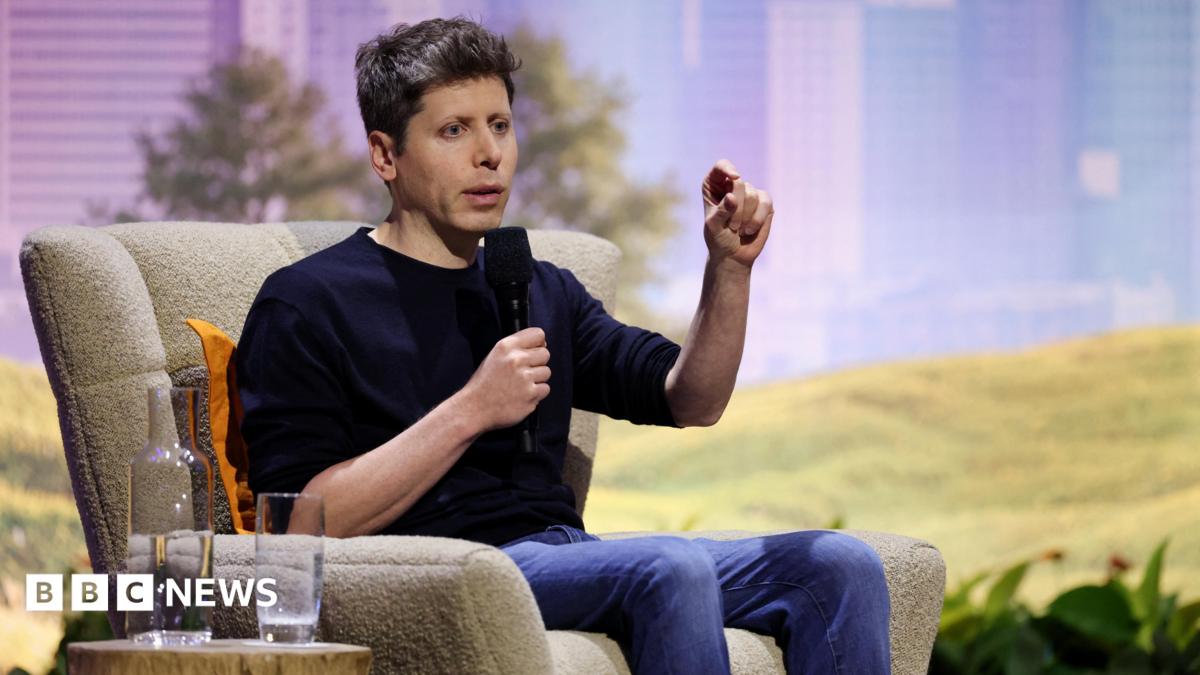
Speaking at an annual technology conference in San Francisco on Tuesday, OpenAI Chief Executive Sam Altman acknowledged that widespread public anxieties regarding the rapid progression of artificial intelligence are completely justified. However, despite admitting that fears surrounding the technology are understandable, the chief executive urged the global public to place its confidence in leading technology firms to govern the development of advanced tools safely without external regulatory intervention.
Addressing a crowd of hundreds of corporate and business leaders at the event hosted by software firm Salesforce, Altman admitted that visualizing catastrophic outcomes from artificial intelligence no longer requires a significant leap of imagination. He noted that the astonishing speed at which these advanced tools are progressing makes heightened public concern natural, yet insisted that tech pioneers possess the moral commitment to manage safety responsibly.
The public appearance marked Altman’s first open remarks since a former employee of rival firm Anthropic generated widespread alarm on social media last week. In a viral post announcing their resignation, the researcher asserted that uncontrolled artificial intelligence could potentially bring about the end of humanity by the close of the decade if left unchecked by developers.
Although a handful of prominent AI executives and industry experts subsequently voiced agreement with the researcher's grim assessment, they provided little explanation regarding how they arrived at their conclusions or how such systems could accomplish such destruction. Nevertheless, the viral warning followed a previous call from Anthropic Chief Executive Dario Amodei for governments to step in with formal regulations and slow down the pace of AI advancement—a proposal initially applauded by Altman, Google DeepMind co-founder Demis Hassabis, and Elon Musk.
By Tuesday, however, the general consensus among prominent technology leaders appeared to pivot strongly away from state regulation in favor of internal corporate oversight. Industry executives increasingly argued that private technology creators themselves are best equipped to manage the inherent safety risks without outside legislative constraints hindering rapid innovation.
Altman vigorously defended the tech sector’s capacity for self-regulation, emphasizing that OpenAI remains committed to doing the right thing due to the immense magnitude of the technology. He pledged that if research teams find themselves unable to maintain ethical alignment and safety measures ahead of raw technical capabilities, development would be deliberately slowed down or halted entirely.
Reflecting on his interactions with federal policymakers, Altman expressed disappointment regarding the absence of legislative action since his testimony before the United States Congress in 2023. He explained that he had anticipated lawmakers would establish a basic regulatory framework long ago, but observed that public officials have consistently struggled to formulate rules without inadvertently slowing down technological innovation.
Prospects for near-term federal legislation in Washington remain slim, despite lawmakers returning to Capitol Hill on Monday following their summer recess. Deep ideological divisions within both major American political parties have stymied legislative progress, while an impending Congressional recess ahead of the midterm elections in early November leaves virtually no operational time for complex technology policy to be enacted.
Joining Altman at the San Francisco event on Tuesday, Nvidia Chief Executive Jensen Huang firmly rejected the necessity for new legislative mandates or regulatory bodies. Huang framed product safety as a technical engineering challenge rather than a matter for outside oversight, arguing that technology companies themselves should decide when next-generation models are ready for public deployment.
Huang asserted that society should not be forced into a false choice between rapid innovation and product safety, noting that companies will naturally take a pause if confidence in a product's stability wanes. Nvidia’s financial standing has experienced exponential growth amid soaring global demand for its hardware, making it the most valuable company in the world by valuation.
Echoing support for corporate autonomy, Meta Chief Executive Mark Zuckerberg outlined his perspective in a post on X. Zuckerberg maintained that every development laboratory operates under powerful market and legal incentives to ensure model safety, cautioning that any firm failing to prioritize ethical alignment risks falling behind competitors while facing immense legal liabilities for potential real-world harm.
Despite these assurances from technology executives, political figures across the ideological spectrum voiced sharp disagreement with the prospect of corporate self-regulation. Left-wing Senator Bernie Sanders criticized the concentration of power, warning that crucial decisions impacting human society are being left to a handful of the world's wealthiest individuals, while former White House strategist Steve Bannon similarly declared that the public cannot trust tech oligarchs to govern themselves.
Academic pioneers also raised serious doubts about relying on corporate self-policing. Turing Award recipient Yoshua Bengio, recognized as one of the founding fathers of modern artificial intelligence, took to X to advocate for ambitious initiatives outside the for-profit sector, arguing that non-commercial efforts are essential to avert the worst potential risks posed by the technology.
In stark contrast to calls for statutory guardrails, US President Donald Trump dismissed widespread warnings about artificial intelligence risks as a hoax. Trump rejected the necessity for greater safeguards, claiming instead that the only guardrail required to manage the technology's rapid expansion is a strong and smart president in office.
While some industry figures contend that resurgent doomsday warnings are overblown and weaponized simply to generate hype for the sector, the fundamental debate over governance remains unresolved. As business attendees departed Tuesday's gathering with instructions from Altman to integrate AI tools into their everyday work, the rift between corporate self-governance and external accountability continues to widen.







(0)