
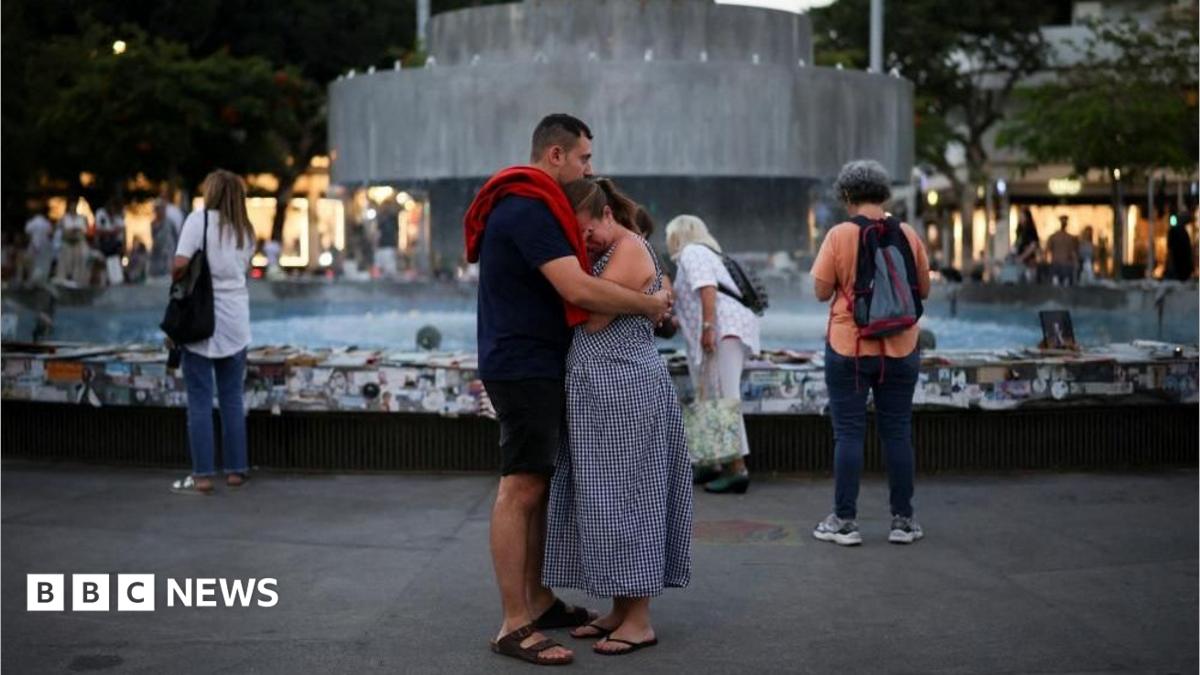
Israel on Wednesday commemorated the third anniversary of the Hamas-led assault that ignited the ongoing war in Gaza, with memorial ceremonies held at the sites of the worst violence and across the country. The attack on October 7, 2023, killed approximately 1,200 people and resulted in 251 others being taken hostage, according to Israeli authorities. Three years later, the pain remains raw for families who lost loved ones, and the political fault lines the attack exposed have only deepened.
At the Nova music festival in southern Israel, where 378 people were killed and 44 taken hostage, bereaved families and survivors gathered on Wednesday morning for a solemn remembrance. The site, located near Kibbutz Re'im and close to the Gaza border, was the scene of the deadliest single incident of the attack. Witnesses have described how festival-goers were shot, sexually abused and tortured by gunmen during the assault, which began at dawn when Hamas-led fighters breached the border. Of the 44 people kidnapped from the festival, only 25 were returned alive from Gaza.
Ahuva Yavin Mayze, whose 21-year-old daughter Adi was shot and killed at Nova, told the BBC that what happened at the site was "dystopic, unimaginable." Her words reflect a grief that has not diminished with time. Shlomo Sharf, a former Israeli footballer, paid tribute to his granddaughter, May Naim, 24, who was also killed at the festival. "Today is a difficult day, not only for me but for a large part of the nation," he said, in comments reported by Channel 12. The festival site has become a place of pilgrimage for mourners, with memorials and photographs marking the lives lost.
At Kibbutz Kfar Aza, where 64 residents were killed and 19 were taken hostage, crowds filed into the small cemetery to pay their respects beside the graves of victims. Zion Regev, a community leader, told Reuters that most surviving residents had yet to return to their homes because of the trauma they endured. "This is the first time we are doing all the things here in the kibbutz," he said. "It's a very emotional day, it's a very difficult day for our community, three years after 7 October." The slow return of residents underscores the lingering psychological toll on communities that were directly targeted in the assault.
The human cost of the attack extends beyond those killed and kidnapped on October 7 itself. Former hostage Yarden Bibas, whose wife Shiri and two young sons, Ariel and Kfir, were kidnapped from their home in Kibbutz Nir Oz and later killed in captivity in Gaza, was quoted by the Times of Israel as saying: "Shiri, Ariel and Kfir. Sorry. Sorry that you are up there and I am here." His words captured the enduring guilt and sorrow felt by those who survived while their loved ones did not.
Israeli Prime Minister Benjamin Netanyahu addressed the nation on the anniversary, saying: "The nation unites on this day in the longing for our dear ones." He also said he had lit a memorial candle commemorating every victim of October 7. "We will complete the mission: we have settled the score and will continue settling the score with all the murderers," he added. At a ceremony on Monday marking the Jewish calendar's anniversary of the attack, Netanyahu said Israel had killed 4,000 out of the 6,000 Palestinians who infiltrated Israel from Gaza that day.
However, the prime minister's remarks were met with protests from Israelis who hold his government responsible for the security failures that allowed the attack to occur. In Tel Aviv's Dizengoff Square, anti-government demonstrators dyed the fountain red to symbolise blood. The fountain has served as a memorial site for those killed, with pictures, flowers and messages laid around the basin wall. Protesters also briefly blocked one of the city's main highways to hold a moment of silence on Wednesday morning. They carried banners reading "the people will remember their sons and daughters," alongside others that said "a complete failure" and "guilty" next to an image of Netanyahu.
The protesters' demands for accountability centre on the absence of an independent state inquiry into the security failures of October 7. Many senior Israeli defence and security officials have resigned or been fired since the attack, but no independent commission of inquiry has been established into what is widely regarded as Israel's worst security failure. The prime minister has rejected any personal responsibility for the failures that day, a stance that has fuelled ongoing anger among segments of the Israeli public.
At the national memorial event at Tel Aviv's Yarkon Park on Wednesday evening, Ido Yakir, a man who reportedly helped fend off Hamas attackers at Kibbutz Magen, praised IDF troops who "fought so bravely" during the raid. He told the crowd that Israel would remember everyone "who knew that they had to give their lives in order to save others." His words highlighted the heroism displayed by some civilians and soldiers even as the broader security apparatus failed.
The anniversary comes as violence continues in Gaza despite a ceasefire agreed almost a year ago. Living conditions for the 2.1 million people in the territory remain dire, according to international aid organisations. In response to the October 7 attack, Israel launched a military offensive in Gaza which has killed more than 74,200 people, according to the Hamas-run health ministry, whose figures are seen as reliable by the UN. The scale of the death toll has drawn widespread international criticism and intensified calls for a lasting political solution.
The third anniversary thus serves as both a moment of collective mourning and a stark reminder of the unresolved questions that continue to divide Israeli society. For the families of the 1,200 killed and the 251 taken hostage, the passage of time has brought little closure. For a nation still grappling with the trauma of October 7 and the subsequent war, the demand for accountability remains as urgent as ever. As one protester's banner declared, "the people will remember their sons and daughters" — a vow that resonates across the political spectrum, even as the path forward remains deeply contested.





(0)