
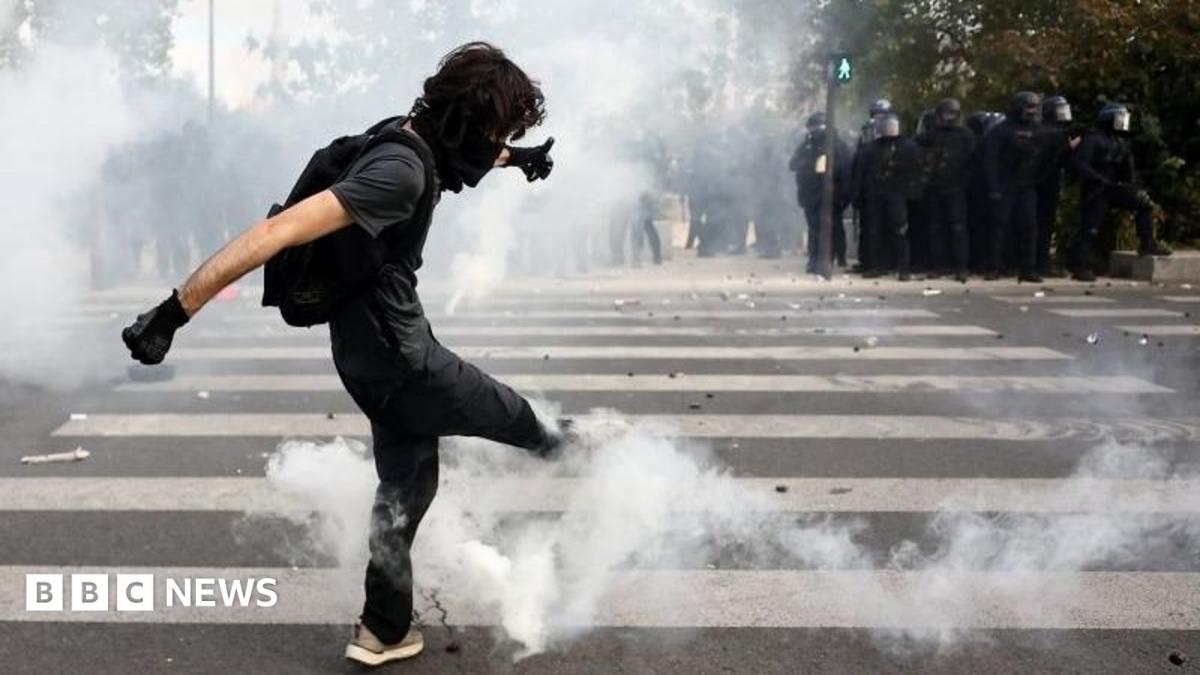
Hundreds of thousands of demonstrators poured onto streets across France on Tuesday as a protest movement that began with high-school pupils expanded to include parents, university students, and trade unions, according to authorities and organisers. The growing mobilisation has become one of the most significant domestic challenges facing the French government in recent months, with tensions flaring in multiple cities and security forces deploying crowd-control measures including tear gas and water cannon.
The protests, which organisers labelled "Act Three" of their campaign, reflect mounting frustration over conditions in France's public education system. What started in mid-September as local anger in Seine-Saint-Denis, a northern Paris suburb, over overcrowded classrooms, teacher shortages, and deteriorating school buildings has since spread nationwide and now touches universities as well. The scope of the movement has surprised many observers, who note that student-led protests in France have historically struggled to sustain momentum beyond their initial weeks.
In Paris, crowds of teenagers marched from the Place de la République, demanding greater resources for schools and an end to what they describe as heavy-handed policing. Clashes broke out between police and demonstrators in Lyon, while officers fired tear gas in both Paris and Marseille. In Rennes, authorities resorted to using a water cannon to disperse crowds. Despite the volatility, the day passed with far less serious disorder than previous rounds of protest, which had been marred by significant violence and property damage.
The human toll from the unrest continues to mount. Prime Minister Sébastien Lecornu condemned the earlier violence and disclosed that 215 students and 85 school staff members had been injured since the protests began, along with 715 police officers. The figure underscores the intensity of confrontations that have occurred at blockades and demonstrations over recent weeks, even as officials insist that most participants remain peaceful.
Estimates of the scale of Tuesday's mobilisation varied sharply between the government and organisers. The interior ministry said more than 250,000 demonstrators took to the streets and reported disruption at 891 high schools — nearly a quarter of all lycées in the country. Student unions, however, put the number of participants at 450,000 and claimed that 1,800 high schools had been blockaded. Such discrepancies are common in French protest movements, where union figures often far exceed official counts, but both sets of numbers suggest a substantial and geographically broad mobilisation.
In Marseille, thousands of demonstrators wound through the city's streets, pausing to chant before moving on as police adjusted their positions. A group of masked protesters seized bollards and bins in an attempt to erect barricades, prompting riot officers to fire tear gas. The crowd dispersed shortly afterward. The scene illustrated the volatile dynamic that has come to characterise the protests, with small groups of radical participants sometimes clashing with security forces while larger crowds of students and families look on.
Students in Marseille described dire conditions in their schools. Alissa, a pupil, insisted that most protesters were not violent and said they had taken to the streets because their schools had been closed and were "falling apart". Her friend Sacha said ceilings were leaking and general conditions were poor, making it difficult to study for extended periods. "We will keep doing this until good measures are taken," he said, suggesting that the movement's demands remain unmet and that further disruption is likely.
The political dimension of the crisis has intensified. In parliament, the prime minister accused the radical-left France Unbowed party of attempting to "sow chaos" ahead of presidential elections scheduled in seven months. President Emmanuel Macron is approaching the end of his second and final term, and France Unbowed leader Jean-Luc Mélenchon currently sits second in opinion polls behind Marine Le Pen of the hard-right National Rally. The government's handling of the protests could therefore carry significant electoral consequences, particularly if the unrest persists or escalates.
Macron was scheduled to chair a meeting with ministers at the Élysée Palace on Tuesday evening to assess the situation, a sign of the seriousness with which the executive branch is treating the crisis. Education Minister Édouard Geffray said he had appealed for dialogue rather than blockades from the outset and complained that "ultra-violent elements infiltrated the high-school student movements". He now faces mounting pressure to deliver a meaningful response to students' grievances, with the measures offered so far — including a website for students to voice complaints and an afternoon of internal discussion in schools on Friday — appearing to have made little impression.
Concerns over police tactics have become a central and contentious issue. France's IGPN police inspectorate has been investigating multiple allegations of "disproportionate force". One officer who fired a tear-gas grenade at a high-school student in Saint-Ouen-l'Aumône, north-west of Paris, has been charged by prosecutors with violence resulting in mutilation or permanent disability. The case has drawn national attention and fuelled arguments that security forces have used excessive force against young people.
The injured student, Eden, 14, was part of a group blockading the Château d'Épluches lycée when he was struck in the face. His lawyer said he suffered a fractured jaw, broken upper teeth, and the loss of four lower teeth. In a separate incident on Monday in the northern city of Lens, a 15-year-old's hand was torn off after a so-called anti-encirclement grenade was fired in unclear circumstances near a school. Authorities maintain the teenager picked up the "sting ball" grenade, which then exploded, while students allege he was hit directly after an officer fired. The local prefect said the incident occurred when police confronted a group of 200 to 250 students throwing stones and fireworks.
The grenade in question is classified as a non-lethal weapon, but its use in proximity to young protesters has reignited debate about the appropriateness of such equipment in crowd-control situations involving minors. The accusations and counter-accusations surrounding these incidents have deepened mistrust between the government and the protest movement, complicating any path toward de-escalation.
There appears to be little prospect of the protests ending soon. The CGT, France's largest trade union, has announced that further demonstrations involving both school and university students are planned for Thursday. The involvement of organised labour signals that the movement may broaden further beyond its original base of high-school pupils, potentially bringing additional pressure on the government and raising the stakes for Macron's administration in its final stretch in office.



(0)