
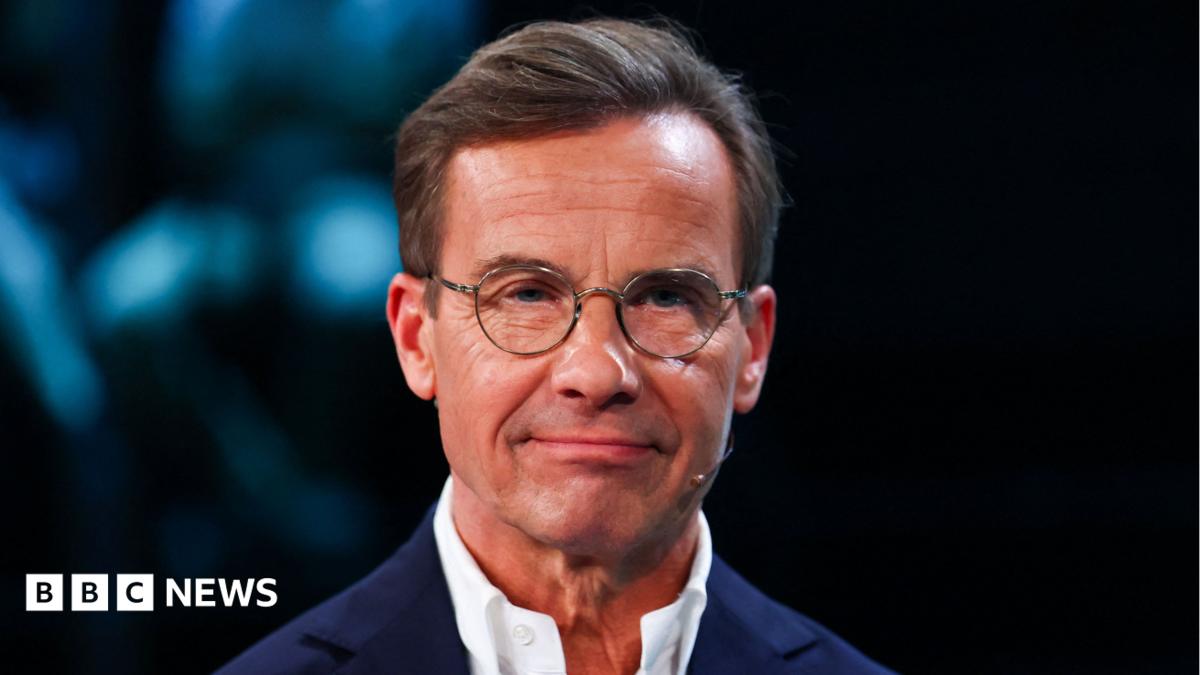
Sweden’s Prime Minister Ulf Kristersson has formally stepped down from his position following a razor-thin general election loss that saw his governing right-wing coalition ousted by the centre-left opposition. The conservative leader’s decision brings an end to his administration after a tightly contested national ballot that dramatically reshuffled the balance of power in Stockholm.
The official announcement came on Thursday afternoon through a message posted on the social media platform X. Kristersson’s concession followed the release of updated preliminary results from Sunday’s voting, which indicated that the incumbent alliance could no longer bridge the gap separating them from the opposition.
In an electorate of approximately 10 million citizens, the national contest was decided on exceptionally tight margins. Official preliminary tallies demonstrated that a mere difference of roughly 50,000 votes across the country ended up deciding the fate of the nation’s executive leadership and establishing a new legislative majority.
According to data compiled and released by the Swedish Election Authority, the centre-left opposition bloc led by Social Democratic leader Magdalena Andersson is projected to capture 176 seats. This total grants her prospective alliance a narrow majority in the 349-seat Riksdag, Sweden’s national parliament.
By contrast, the outgoing right-wing governing bloc is on course to secure 173 seats, falling just three mandates short of retaining legislative control. While the seat allocation reflects near-complete tabulations, election authorities have noted that the figures remain subject to formal certification, which is scheduled to conclude over the coming weekend.
The result marks a major setback for Kristersson, who led a coalition comprising his own Moderate Party alongside the Christian Democrats and the Liberals. Throughout his tenure, the conservative prime minister relied on the external support of the hard-right, anti-immigration Sweden Democrats (SD) to maintain a functional governing majority.
Ahead of the election, Kristersson had made a significant political gamble by promising the Sweden Democrats official cabinet posts in a future administration if the right-wing bloc secured re-election. This prospective integration represented a major elevation for the hard-right faction, which had historically been kept outside the formal executive branch despite offering legislative backing.
However, the political calculations of the incumbent alliance were severely undermined by an unexpected decline in support for the Sweden Democrats. For the first time since the party initially crossed the threshold to enter the Swedish parliament in 2010, its share of the popular vote fell, dropping three percentage points in comparison to its performance in the 2022 general election.
During their term in power, the centre-right government and its hard-right allies had focused heavily on implementing a dramatic tightening of Sweden’s migration rules. Despite these sweeping legislative and regulatory overhauls, the right-wing alliance was ultimately unable to maintain the voter backing necessary to sustain its legislative majority.
With Kristersson stepping aside, former prime minister Magdalena Andersson has quickly moved to initiate coalition discussions with potential partners. Her outreach involves three other opposition entities: the Left Party, the Centre Party, and the Green Party, all of which are essential to cementing a governing majority.
Despite holding the numerical advantage in parliament, the process of forming a stable executive is expected to be delicate and potentially prolonged. Significant ideological disagreements exist across the prospective four-party coalition, particularly regarding taxation policies and broader economic management, where the market-oriented Centre Party often clashes with the Left Party.
Such intricate inter-party negotiations are a familiar feature of the Swedish political system, which is fundamentally organized around two primary four-party blocs representing the left and right. Because power is broadly distributed and single-party majorities are rare, Swedish voters and institutions have long grown accustomed to navigating complex minority administrations and coalition arrangements.
Historical precedents suggest that resolving these policy divisions could take considerable time. Following the 2022 general election, it required 37 days of intensive negotiations before Kristersson could assemble his administration, while the exceptionally fraught inter-party talks following the 2018 national ballot extended over 134 days before a government could be confirmed.
The final phase of the vote-counting process had extended across several days after polling stations closed on Sunday evening. The narrowness of the initial counts meant that decisive conclusions were deferred until Wednesday, when local electoral committees began processing late-submitted advance ballots along with votes cast by Swedish citizens residing abroad.



(0)