
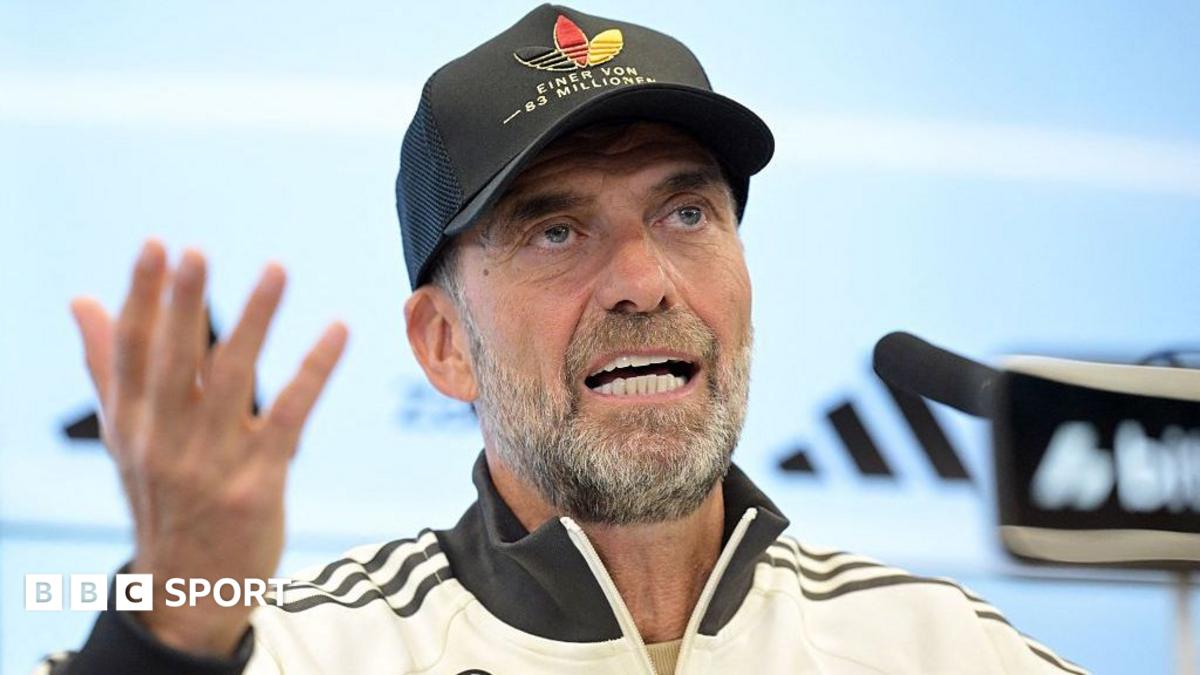
Jurgen Klopp has declared that his national team can play an active role in ensuring national symbols remain inclusive, warning that national pride must not fall into the hands of the wrong people following recent political gains by the far right. The newly appointed Germany head coach addressed the wider political and social landscape during his first squad announcement press conference, articulating a vision for a country united by sport and shared civic values.
The former Liverpool manager spoke directly in response to recent regional election developments, where the anti-immigration Alternative for Germany party secured 43.8% of the vote in Saxony-Anhalt. That result left the party just short of an absolute majority in the eastern state's parliament, with the organisation also anticipating strong returns in forthcoming ballots in Berlin and Mecklenburg-Western Pomerania.
The rise of the far-right party carries deep historical significance across the nation, as no far-right political entity has held power in a German state since the end of the Second World War, when the governing Nazi regime perpetrated the Holocaust. Against this backdrop, the manager used his platform to reflect on the mood across the country and the role football can play in bringing citizens together.
While Klopp acknowledged from the outset that he does not view himself as a political expert, he observed the sharp division in public sentiment triggered by recent voting patterns. He noted that while some citizens viewed the electoral outcomes as acceptable, others were left asking with alarm what was happening to the nation.
Approaching the issue through the lens of a sporting figure, Klopp expressed a deep desire to reclaim the German national flag on behalf of the entire population. He voiced his hope that waving the national flag should never provoke concern or make onlookers question a person's motives, but rather serve as an expression of appreciation and good fortune for living in the country.
Klopp stressed that celebrating the nation should reflect the joy of having been born, raised, or welcomed into Germany as an immigrant. To avoid the divisive connotations often associated with standard concepts of national pride, the manager explained that he prefers using the phrase positive patriotism, which he believes captures a healthier and more inclusive relationship with national identity.
Elaborating on this distinction, Klopp insisted that being proud to be German does not conflict with maintaining progressive values. He affirmed that national identity can seamlessly coexist with being open-minded, diverse, kind, and friendly, rejecting any notion that patriotism belongs exclusively to exclusionary political factions.
The Germany coach also placed sport within a balanced societal perspective, noting that football is not the nation's most urgent priority compared to having adequate numbers of healthcare professionals and caregivers. However, he maintained that the game holds exceptional power to bridge divides, foster community spirit, and remind citizens of the unifying potential inherent in athletics.
Klopp's comments accompanied the unveiling of an expansive 44-man roster designed to navigate a demanding run of four UEFA Nations League fixtures scheduled across a two-week window. The massive list of call-ups, which features 16 uncapped players, marks the beginning of Klopp's on-field rebuilding project following his departure from his role as global head of soccer for Red Bull.
The national team position became vacant after Julian Nagelsmann departed the post in the wake of Germany's second-round elimination at the hands of Paraguay in this summer's World Cup. That tournament disappointment also prompted the international retirements of veteran stalwarts Manuel Neuer and Antonio Rudiger, accelerating the need for generational renewal.
To manage player workloads across the compressed international window, Klopp has structured his selection into two distinct groups. An initial 24-player contingent will assemble to prepare for an away meeting against the Netherlands in Amsterdam on 24 September, followed by a home encounter against Greece in Augsburg three days later.
Following those two fixtures, the majority of the first group will be released back to their respective clubs, making way for a second cohort of 20 players. This incoming group will take over national team duties for Germany's clash with Serbia in Munich on 1 October, before concluding the window with a visit to Greece in Thessaloniki on 4 October.
The opening squad selection features a strong Premier League presence, including Arsenal forward Kai Havertz, Brentford attacker Kevin Schade, and Leeds midfielder Anton Stach. Also included in the first group is Bayern Munich playmaker Jamal Musiala, who earned his spot despite experiencing two collapses during pre-season fixtures with his club.
The subsequent 20-man group includes Brentford's Vitaly Janelt, who has earned his maiden international call-up, alongside Liverpool's Florian Wirtz and Newcastle defender Malick Thiaw. Through this split squad approach, Klopp aims to balance tactical experimentation and physical recovery while steering German football into a renewed era on and off the pitch.





(0)