
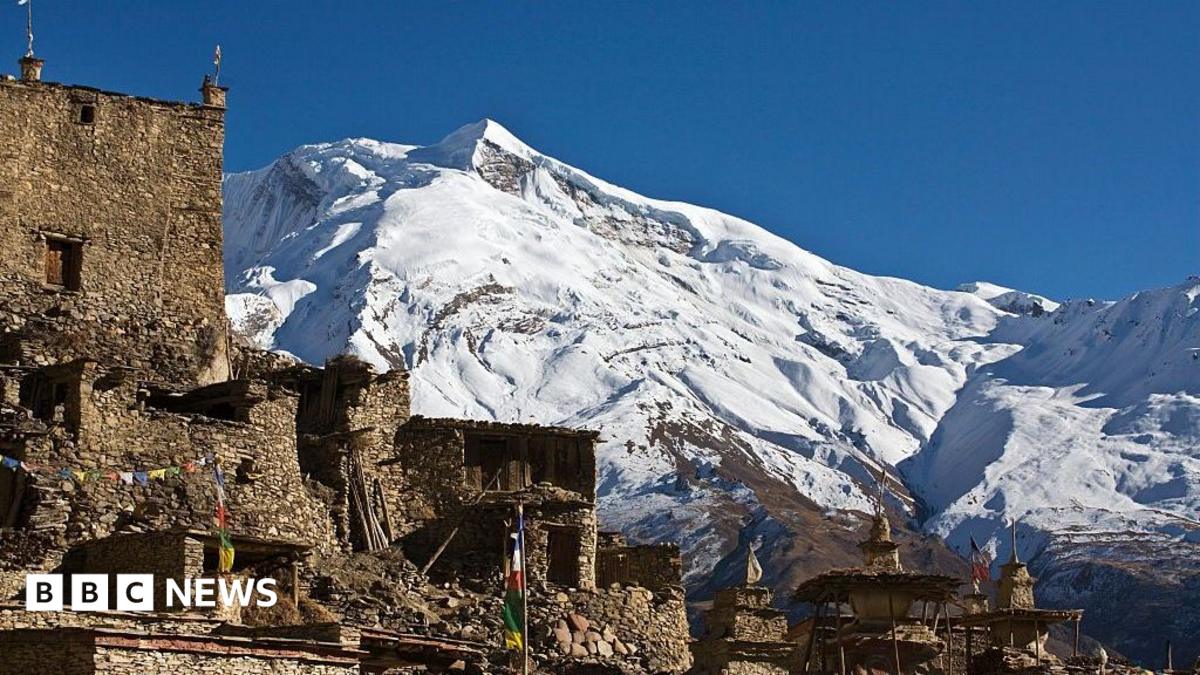
At least ten Nepali climbers are missing following an avalanche that tore through a staging camp high in the Himalayas on Sunday morning, according to expedition organisers. The local guides had been dispatched ahead of a paying client group to prepare the route on Himlung Himal, a peak that sits near Nepal's northern frontier with Tibet, when the snowslide struck without warning.
The missing men were part of a team employed by Himalaya Holidays Trekking, a Kathmandu-based operator that runs expeditions to some of the region's most demanding summits. Bibhuti Chand Thakur, a representative of the company, confirmed the scale of the incident to the AFP news agency, stating that eight members of its own expedition crew and two additional guides from a separate company had been reported unaccounted for. The ten were positioned at a staging point close to the mountain when the avalanche descended on Sunday morning.
Himlung Himal rises to an elevation of 7,126 metres, or roughly 23,380 feet, placing it among the higher trekking peaks in the Nepalese Himalaya that are marketed to experienced foreign climbers. It lies in the Manang district, a rugged region north-west of the capital Kathmandu that has become increasingly popular with international expedition companies in recent years. The peak's relative accessibility and its proximity to the Tibetan plateau make it an attractive objective for mountaineers seeking a serious high-altitude challenge without the extreme technical difficulties of an 8,000-metre summit.
The role played by the missing men reflects a longstanding and often underappreciated feature of Nepal's climbing industry. Known locally as Sherpa guides or high-altitude workers, these Nepali professionals are routinely sent up the mountain before their foreign clients arrive. Their task is to establish camps, carve out safe routes through crevasse fields, and fix the ropes that paying climbers will later clip into as they ascend. This advance work is essential to the commercial expedition model, but it also places Nepali crew members in the most hazardous positions, often during the least stable weather windows of the season.
Conditions on and around the mountain had deteriorated markedly in the days leading up to the disaster. Forecasts indicated heavy snowfall across the region, loading the slopes with fresh snow and sharply increasing the risk of avalanche activity. The accumulation of new snow on steep alpine terrain is a well-known trigger for slab avalanches, particularly when underlying layers have not had time to bond with the newly deposited snowpack. Experts in mountain safety note that such conditions can persist for days after a storm clears, meaning the danger does not necessarily recede once the snowfall stops.
Rescue operations have been severely constrained by the same poor weather that preceded the incident. Helicopters have been unable to reach the site, and ground-based rescue teams have likewise been prevented from accessing the area. High winds, low cloud and continuing precipitation are common obstacles to high-altitude rescue in the Nepalese Himalaya, where aircraft operate at the limits of their performance envelopes and even brief windows of clear weather can be difficult to identify and exploit. The inability to reach the missing climbers quickly is a critical factor in their prospects, as survival in such environments depends heavily on the speed with which search teams can locate and extract casualties.
The incident is the latest in a series of weather-related emergencies affecting Nepal's trekking and mountaineering sector, which represents a significant component of the country's economy. The industry generates employment for thousands of guides, porters and support staff, and brings in substantial foreign currency through permit fees, equipment purchases, accommodation and transport. Disruptions caused by extreme weather therefore carry consequences that extend well beyond the immediate human toll, affecting the livelihoods of communities in mountain districts that depend on climbing tourism.
Earlier in the week, climbers were compelled to abandon Mount Manaslu, the eighth-highest mountain in the world, because of a growing avalanche threat. The evacuation of teams from Manaslu underscores how widespread the unstable conditions have become across the Nepalese Himalaya, rather than being confined to a single peak or valley. Persistent rain and snow have been reported across Nepal's mountain districts in recent days, creating treacherous terrain for both guided expeditions and independent climbers.
The tragedy also echoes a recent loss that shocked the global mountaineering community. Less than two months ago, six climbers died on Broad Peak in Pakistan, among them Nirmal Purja, the renowned British-Nepali mountaineer whose record-breaking feats had brought him international fame. Purja's death drew widespread attention to the risks faced by high-altitude workers and the often disproportionate dangers borne by Nepali professionals in the service of commercial expeditions.
The catastrophic weather in the Himalayas is not limited to Nepal. Officials in the neighbouring Indian region of Uttar Pradesh, further south, have reported that extreme conditions there have killed more than fifty people. The scale of the loss across the wider region highlights how severe and widespread the meteorological disruption has been in recent weeks.
Meanwhile, recovery operations continue along the Nepal-Tibet border, where more than 6,000 people remain missing following a massive flood and landslide in August. That disaster, triggered by a glacial collapse in the Himalayas, sent enormous volumes of water and debris surging down the Trishuli River valley, sweeping away settlements and infrastructure in its path. More than 1,400 deaths have been confirmed in connection with the event, making it one of the deadliest natural disasters to strike the region in recent memory.
The combined weight of these events has placed Nepal's emergency response capabilities under intense strain. Authorities are simultaneously managing the aftermath of a large-scale flood disaster, the ongoing search for thousands of missing persons, and now a high-altitude avalanche involving multiple expedition companies. The cumulative pressure on rescue services, medical facilities and local government resources is considerable, particularly in remote mountain districts where access is already difficult under normal circumstances.
For the families of the ten missing guides, the wait for information is compounded by the knowledge that rescue teams cannot yet reach the site. The coming hours are likely to be decisive, as any improvement in weather could open a narrow window for helicopter reconnaissance or ground penetration. Should conditions remain closed, however, the operation may be delayed further, deepening the uncertainty surrounding the fate of the men who were sent ahead to make the mountain safe for others.








(0)