
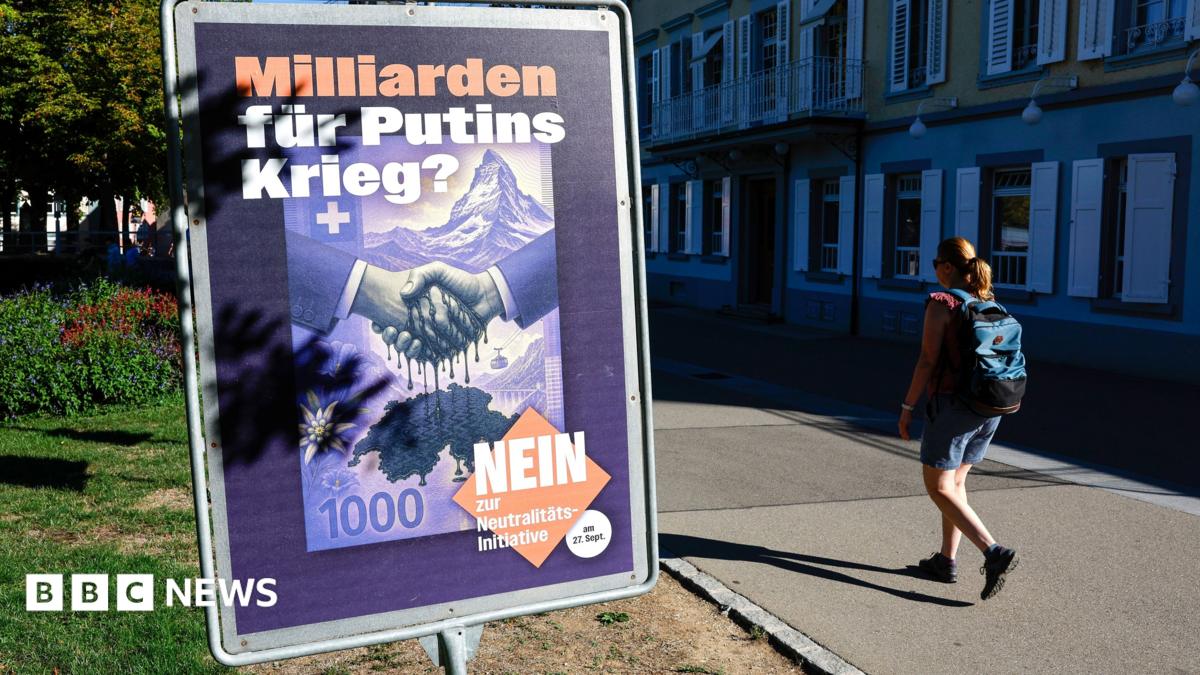
Swiss voters have decisively turned down a package of measures that would have tied the Alpine republic's hands when it comes to imposing sanctions, with official results showing more than 70% of those who cast a ballot opposed the "Neutrality Initiative."
The referendum, backed by the right-wing Swiss People's Party (SVP) and openly championed by Moscow, sought to redefine the country's longstanding tradition of diplomatic neutrality. Had it passed, Switzerland would have been required to obtain the green light of the United Nations Security Council before joining any sanctions regime, and would have been barred from moving towards closer integration with the Nato military alliance.
Official figures indicated a decisive result rather than a close call, underlining how strongly the country's electorate has resisted any narrowing of its room for manoeuvre at a time of European war. Russia's full-scale invasion of Ukraine, launched in February 2022, had transformed a once largely academic question about Swiss non-alignment into one of immediate foreign policy consequence, and prompted the most intense reappraisal of the doctrine since it was codified more than two centuries ago.
Analysts cautioned against reading the vote as a repudiation of neutrality itself. Lukas Golder, co-director of the Gfs.bern research institute, told Swiss public broadcaster SRF that the electorate had not rejected the idea that Switzerland should remain neutral, and that the outcome instead revealed public support for the government's willingness to take action against Moscow. In his reading, the campaign did little to persuade voters that binding national action to supranational approval was a price worth paying; what it demonstrated, he said, was that Swiss voters grasp what the doctrine of neutrality is actually for.
That distinction matters because the initiative was packaged by its backers as a defence of an ideal rather than a restriction of action. Critics of the SVP's approach have argued that tying sanctions to a UN veto hands effective veto power to any permanent member of the Security Council — including the very state whose conduct the measures are meant to punish. Russia's backing, openly declared, lent the campaign an association that appears to have done little to broaden its appeal inside Switzerland.
The government had campaigned against the proposals, as did every other major party. Foreign Minister Ignazio Cassis made the government's case during a televised debate, arguing that neutrality has always been applied with a degree of flexibility rather than treated as an inflexible rule. He said the country had no intention of lifting its prohibition on arms sales to nations in conflict — a policy that applies to Ukraine as much as anywhere else — while stressing that neutrality is not the same thing as indifference.
Cassis also framed Switzerland's position in terms of its stake in a rules-based international order, saying the country would not simply avert its gaze when it sees violations of the very rules that make peaceful life possible for its citizens. That formulation captures what supporters of a conditional neutrality see as the doctrine's core function: a Switzerland that is at peace and free precisely because the broader system of international law holds, and which is therefore reluctant to stand aside when that system is openly flouted.
The origins of Swiss neutrality are well understood. The country was granted what amounts to permanent or "eternal" neutrality at the Congress of Vienna in 1815, during a period of sustained war and upheaval across Europe. Its legal parameters were set down by the Hague Convention of 1907, which prohibits Switzerland from supplying weapons to countries engaged in war — the provision that underpins the current arms embargo. It is a ban with real-world consequences: the government previously turned down a request from Germany for ammunition for tanks bound for Kyiv.
Switzerland also maintained its neutrality throughout the Second World War. The wartime record is considerably more complicated than the word "neutral" alone conveys. The country accepted gold looted by the Nazis, and in an effort to avoid provoking an invasion that might have been disastrous for its civilian population, it turned away thousands of Jewish refugees who sought safety on Swiss soil. Swiss authorities apologised for those policies in the 1990s, following years of uncomfortable examination of a period in which survival and humanitarian responsibility came into sharp conflict.
The referendum is the latest in a long line of decisions on big questions of state policy that have been punted to Swiss voters. Because of the country's system of direct democracy, major political choices are frequently settled at the ballot box rather than in parliament, and constitutional or statutory questions relating to neutrality and international law have been a recurring feature of that process.
Analysts say the result leaves the government's existing approach intact, while making clear that any future attempt to codify neutrality more strictly will face organised resistance from the centre-left and centre-right parties that joined forces against the initiative. The diplomatic question now is less about whether Switzerland can act alone and more about how far it can work with partners whose own frameworks — EU sanctions policy, for instance — already operate largely without Swiss input.
The immediate consequence is continuity: sanctions regimes can be joined without seeking UN authorisation, ties with Nato can be examined on their merits, and the arms embargo remains in place. The deeper message sent by voters, on the reading of Golder and the argument made by Cassis, is that they regard neutrality as a policy instrument with a purpose, not a wall to be raised regardless of the circumstances. The doctrine survives the referendum not as an unexamined habit, but as something the electorate has, in effect, decided to keep flexible.
For Russia, the outcome removes a potential diplomatic ally in the heart of Europe. For Bern, it settles a debate — at least for now — in favour of the position it has defended for two centuries, with the caveat that two centuries of history include a record Swiss leaders themselves have spent decades reckoning with.




(0)