
The Renton City Council is scheduled to take formal action on a proposed ordinance that would prohibit unauthorized camping on public property throughout the municipality. The upcoming vote marks a potential turning point for local governance, positioning Renton among a growing number of jurisdictions in Washington State that have sought to clear public spaces of makeshift shelters and unsanctioned encampments.
If adopted, the measure will follow in the footsteps of several neighboring communities, including Lakewood, Tukwila, and Burien, which recently instituted their own municipal prohibitions against public camping. These regional legislative actions have emerged in response to evolving legal standards established by the highest court in the country.
The recent flurry of local municipal bans was largely catalyzed by a landmark ruling from the Supreme Court of the United States. In that decision, the nation's high court determined that municipal ordinances prohibiting individuals from camping on public land do not violate the Eighth Amendment's constitutional protections against cruel and unusual punishment, granting local governments broad legal authority to enforce such restrictions.
Under the specific provisions outlined in Renton's draft ordinance, individuals will be strictly prohibited from setting up temporary living quarters on any municipal land. This prohibition includes barring anyone from erecting tents, stringing up tarps, or constructing other improvised protective structures on property owned and managed by the city.
The regulatory reach of the proposed law encompasses a broad array of civic environments across the city. Prohibited zones explicitly include municipal parking lots, public walking and biking trails, community parks, and various other public spaces that fall under city jurisdiction.
Beyond the ban on erecting temporary shelters, the proposed ordinance places stringent limits on everyday activities and personal belongings often associated with outdoor survival. It explicitly outlaws the building or maintaining of fires on city-owned property, a provision aimed at curbing potential safety hazards in public areas.
Furthermore, the draft legislation strictly prohibits individuals from utilizing public grounds to store personal gear or stash shopping carts. City officials have highlighted these measures as necessary steps to keep public spaces clear, clean, and accessible for general community use.
To administer and enforce the new rules, the city intends to establish formal trespassing zones across municipal territory. Individuals who fail to heed warnings to vacate these public properties could face escalating legal consequences from municipal authorities.
Under the framework of the proposal, repeat violators who refuse to comply with the camping restrictions can be formally charged with a misdemeanor. In Washington State, misdemeanor offenses carry potential criminal penalties of up to ninety days in jail, as well as monetary fines of up to one thousand dollars.
While the proposed law introduces significant criminal penalties for repeated non-compliance, it also incorporates provisions intended to address the underlying needs of the unhoused population. The text of the ordinance mandates that individuals experiencing homelessness must be offered access to outreach assistance and supportive social services prior to severe punitive actions.
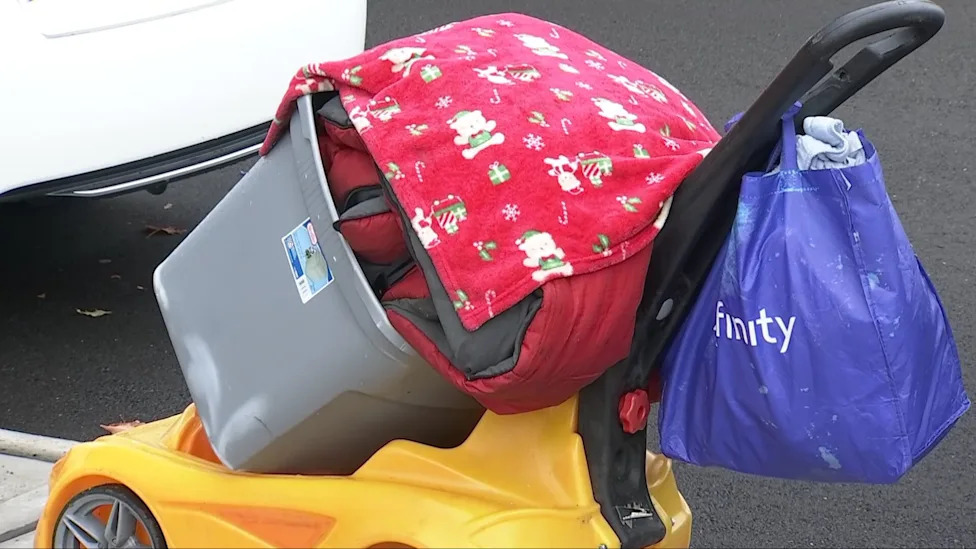
The impending council vote has prompted concern among members of the local homeless community, who worry about the immediate practical impact on their daily survival. Among them is Nicole, an unhoused woman who navigates the streets of downtown Renton pushing a child's toy car loaded with her few remaining worldly possessions.
Nicole revealed that she has been homeless for approximately three to four years, having lost everything she once owned before ending up on the streets. She explained that she routinely depends on public parking lots as places to sleep each night, relying on these open areas as her only viable shelter options.
When asked about moving into organized shelter facilities, Nicole expressed an intense distrust of institutional lodging. She maintained that she avoids local shelters entirely because she considers them unhealthy and unsafe, emphasizing that she would far rather take her chances sleeping exposed on public sidewalks than stay inside a shelter environment.
For individuals like Nicole, the prospect of having parking lots, parks, and sidewalks declared off-limits leaves an uncertain path forward. With the looming introduction of trespassing zones and misdemeanor penalties, unsheltered residents who harbor deep reservations about shelters face shrinking options for where they can legally exist with their possessions.
Advocates and service professionals in the region have offered a different perspective, maintaining that clear legal boundaries can coexist with humanitarian assistance. Max Komar, a representative from the non-profit outreach organization Battlefield Addiction, argued that effective policy must blend genuine compassion with direct personal accountability.
Komar's organization works closely with individuals battling severe substance use disorders, many of whom ultimately find themselves living in unsanctioned outdoor camps. While recognizing the vulnerability of those on the streets, Komar stressed that surrounding neighborhoods, families, and residents also have a fundamental right to safe, secure public spaces free from open-air drug activity and hazardous encampments.
According to Komar, well-crafted municipal regulations can accomplish both goals simultaneously. By setting clear standards that discourage dangerous and unsanctioned camping while aggressively connecting unhoused individuals to vital care and rehabilitation resources, the community can protect public safety while helping vulnerable residents transition toward long-term recovery.





(0)