
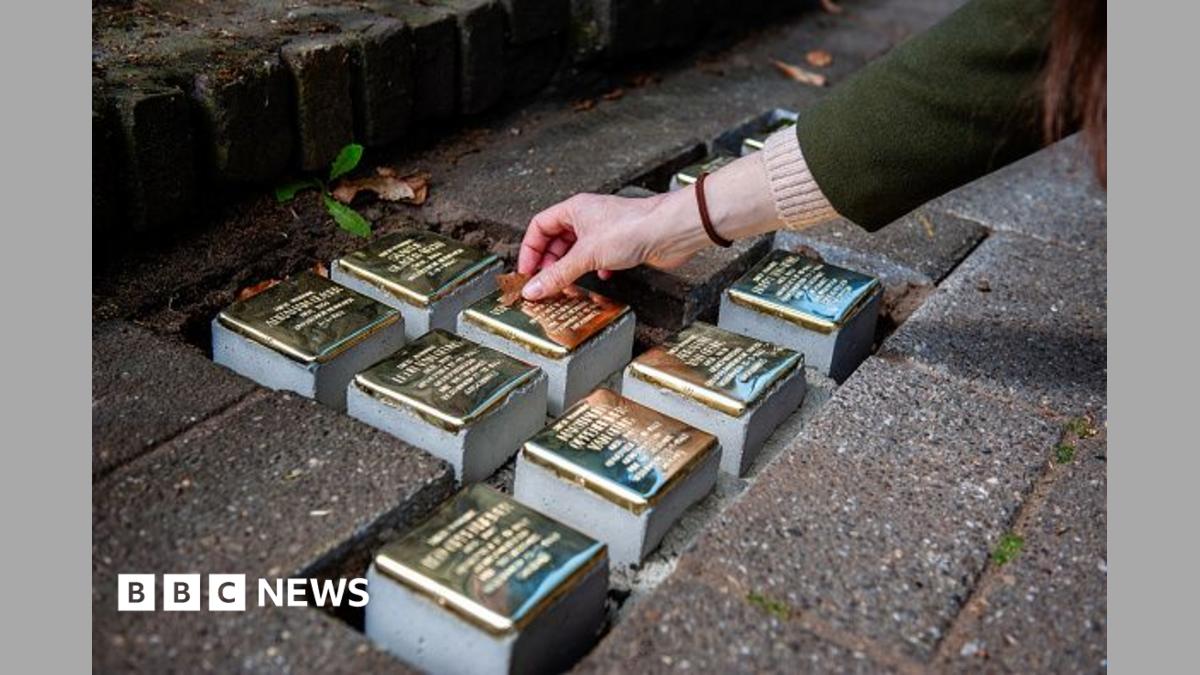
A wave of criticism has swept Germany after the town of Heidenau, near Dresden in the eastern state of Saxony, voted to prohibit the installation of "stumbling stone" memorials honouring victims of the Nazi era. The decision, taken by members of the far-right Alternative für Deutschland (AfD) and the mainstream conservative Christian Democratic Union (CDU), has been condemned as an affront to Holocaust remembrance by figures including the country's federal education minister.
Since the 1990s, small brass plaques set into pavements and streets have become one of the most visible forms of memorialisation across Europe. The stones — Stolpersteine in German — are typically laid outside the buildings where Jewish residents and other victims of Nazi persecution once lived or worked, marking the site of a former life rather than a mass grave or official monument. Many are financed by public donations, and the idea has spread steadily through towns and cities in Germany, Austria and beyond, with prominent examples installed in cities including Berlin, where stones are placed near the Reichstag.
In Heidenau, councillors from the AfD and the CDU backed a motion blocking the memorials within the town. The motion argued that a significant number of local residents considered this style of commemoration of Nazi victims inappropriate. It also proposed that any such memorials should in future be relocated to the city's Nordfriedhof cemetery, on the stated grounds that this would make it "impossible to step directly onto the memorial elements".
Federal Education Minister Karin Prien, who told the Bild newspaper that the ban was a "scandal", said anyone who pushes Stolpersteine and other memorials to Jewish life out of public space and into the cemetery is "prioritising death over life and rendering Jewish people invisible once more". She also acknowledged that her own party bears part of the blame, pointing to the CDU's responsibility in the decision at a time of growing influence for the right.
Charlotte Knobloch, a Holocaust survivor and president of the Jewish community in Munich, was equally unimpressed, describing the removal of memorials from the townscape as "completely the wrong approach". Speaking to the Funke Media Group, she said she was appalled that a democratic party would back what she characterised as a transparent manoeuvre by AfD extremists.
Knobloch offered a note of nuance. While she is not personally a supporter of stumbling stones, she argued that decentralised remembrance — one that is not banished from public space but instead permeates and shapes it — is essential to a genuine culture of remembrance. Her remarks underline a broader tension in German public life over who should decide where and how the Holocaust is marked, and whether commemoration belongs in the intimate geography of everyday streets or confined to formal memorial sites.
In Munich, Knobloch's own city, there are no Stolpersteine on municipal land. Instead, the city permits memorial plaques on public buildings, an approach that has drawn its own criticism from campaigners who regard the substitution as a weakening of the decentralised model. The Heidenau vote takes that debate a step further by seeking not to relocate or redesign the plaques but to remove them from the town's public realm altogether.
Gunter Demnig, the artist who initiated the Stolperstein project, said the decision was, in the current political climate, hardly surprising. Given the AfD's recent run of electoral successes, he said, "it was certainly to be expected that something like this would happen". He was referring to the right-wing populist party's strong results in state elections in Saxony-Anhalt and Mecklenburg-Vorpommern, both in Germany's former communist east.
The AfD has been classified by German domestic intelligence as extreme-right, and the party rejects that designation. Some branches of the party are classed as right-wing extremist, according to security officials. Its anti-immigration stance, "Germany first" platform and friendly posture towards Russia have struck a particularly strong chord in the eastern German states, decades after the end of communist rule and amid economic strains in the region.
The Heidenau motion is the latest in a series of local measures that critics have linked to a broader attempt to reshape Germany's culture of remembrance. Its supporters frame the ban as a response to residents' feelings; opponents argue that concentrating memorials in a cemetery reverses decades of grassroots work and reduces the visible presence of Jewish life in German towns to a single, quieter location.
The backlash, however, has been swift and unanimous across the political and civic spectrum covered by the report. A federal minister from the party that shares responsibility for the vote, a survivor who leads one of Germany's largest Jewish communities, and the artist behind the memorials have all publicly rejected the decision — suggesting that the row is unlikely to die down quickly in Heidenau, in Saxony, or further afield.







(0)