
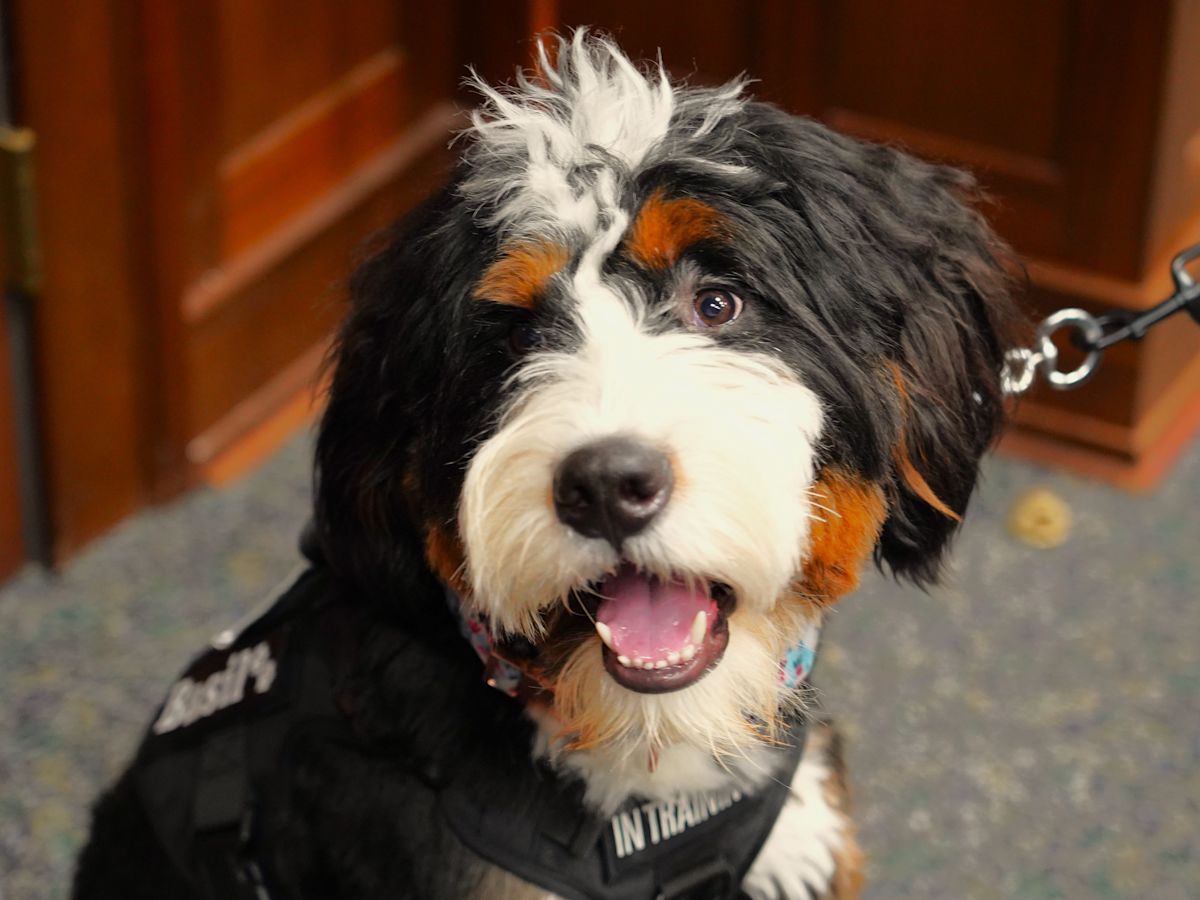
For many citizens, discovering a jury summons in the mailbox triggers a feeling of dread and inconvenience. In Hamilton County, Ohio, however, those selected for grand jury duty are greeted with an unexpected source of comfort: an affectionate, white-furred therapy dog named Basil. Stationed within the local prosecutor's office, the canine helps soften the demanding and often emotionally taxing duties that come with evaluating criminal allegations.
Recognizable by his signature mop of white hair, perpetual grin, and personalized vest, Basil regularly walks the hallways alongside detectives, prosecutors, and office staff. His official mission is to offer steady emotional support not only to crime victims and their families navigating the aftermath of traumatic events, but also to the citizen jurors tasked with reviewing disturbing evidence in felony investigations.
Serving on a grand jury looks vastly different from the high-stakes courtroom drama typically depicted in popular media. Grand jurors do not sit in a traditional elevated jury box inside a public courtroom, nor are they tasked with deciding whether a defendant is ultimately guilty or innocent beyond a reasonable doubt. Instead, these bodies function in a private setting to evaluate whether allegations warrant moving forward to a full criminal prosecution.
Selected randomly from local voter registration records and driver's license rolls, these citizens gather nearly every weekday. In addition to Basil's calming presence, grand jurors enjoy other practical conveniences during their two-week service terms, notably avoiding the lengthy security checkpoints and bustling foot traffic of the main Hamilton County courthouse by meeting in a nearby administrative building.
Grand juries serve as a foundational element of criminal procedure in approximately half of all U.S. states. Under Ohio law, grand jury reviews are reserved for serious felony allegations rather than minor offenses. In Hamilton County, the panels examine all felony-level cases as well as any misdemeanor charges directly connected to an underlying felony offense.
Rather than rendering a final verdict, the primary directive of the grand jury is to determine whether probable cause exists. As outlined by the Ohio Judicial Council, members are instructed to assess whether the presented evidence is sufficiently reliable and credible to establish that the accused individual probably committed the offense in question.
The proceedings are inherently one-sided compared to regular trials. The accused person and their defense counsel are not present to argue their case or cross-examine witnesses. However, grand jurors are given the unique opportunity to directly question investigating police officers and other witnesses who appear before them to present the prosecution's evidence.
Each grand jury panel in Hamilton County consists of nine members alongside alternates. To return an indictment—allowing criminal charges to formally proceed—at least seven of the nine jurors must vote in favor. If the threshold is not met, the case is dropped in an outcome known legally as a "no bill" or an "ignored" case, though prosecutors retain the right to present the matter again should new evidence surface.
The civic commitment entails an intense, fast-paced workload. Over the course of a typical two-week term of service, a single grand jury panel may review 100 cases or more, requiring close attention to detail and rapid transitions between vastly different criminal allegations.
Hamilton County Prosecutor Connie Pillich explained that the immense volume of criminal filings requires grand juries to convene Monday through Friday, 52 weeks a year, pausing only for specific holidays. Because of the county's large population, two separate nine-member panels, accompanied by alternates, operate simultaneously every business day, collectively reviewing more than 5,700 cases in 2025.
The hearings take place inside the Hamilton County Prosecutor's Office building on Ninth Street, situated one block away from the primary courthouse. The rooms are comparatively intimate and lack the high ceilings or open space of formal courtrooms. Decades of continuous daily use are visibly etched into the wood-paneled walls, which bear deep scuffs and wear marks from the backs of jurors' chairs.
To make the working environment more functional and comfortable, Kate Burroughs, who assumed the role of Chief of Grand Juries and Intake in January 2025, initiated several office improvements with the help of her daughters. Their volunteer efforts included cleaning the facilities, patching up worn chairs, adding tables, and installing a television monitor so detectives no longer have to pass around mobile phones to display photo and video evidence.
To prepare jurors for their duties, the first day of service begins with an extensive legal orientation. Court officials guide the newly empaneled citizens through essential statutory definitions—explaining legal thresholds for concepts such as "knowingly," "recklessly," and "possession," alongside current Ohio firearm laws. The panel is eased into the routine with a lighter docket on day one before tackling more complex files.
As Prosecutor Pillich observed, the daily proceedings operate without the performative theatrics common in public trial courts. The majority of the cases reviewed involve drug possession and drug trafficking charges, making the grand jury an essential gatekeeping mechanism that ensures the justice system processes serious criminal charges with rigor, efficiency, and a touch of canine companionship.




(0)