
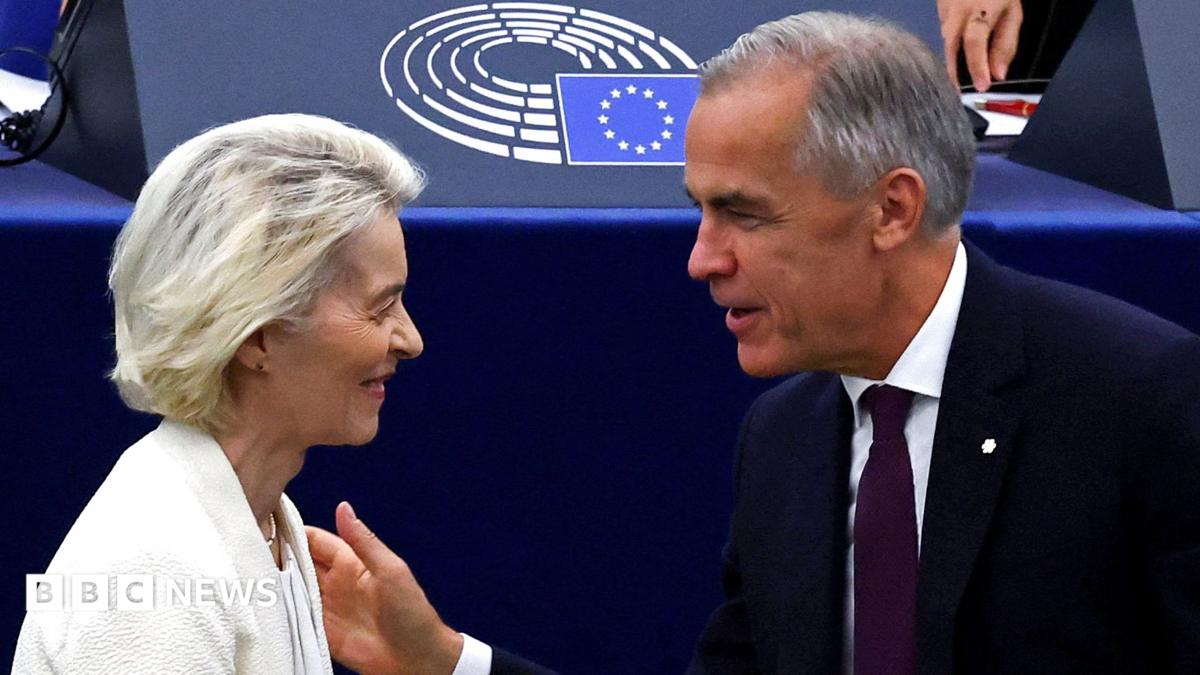
European Commission President Ursula von der Leyen has formally endorsed a landmark initiative to grant Canada a newly conceived "associate member" status within the European Union. The proposal marks a dramatic effort to deepen ties between Brussels and Ottawa at a time when traditional transatlantic relationships are undergoing significant strain and geopolitical uncertainty is reshaping international diplomacy.
Delivering her annual State of the Union address to the European Parliament in Strasbourg, von der Leyen announced that she intended to begin the work of opening the European Union's doors to Canada. She emphasized that bringing the bilateral partnership to its highest attainable level would foster collective strength and provide a coordinated response to the growing fractures within the international rules-based order.
Canadian Prime Minister Mark Carney was seated in the parliamentary gallery during the keynote address and is slated to deliver his own speech to European lawmakers on Thursday. Carney has actively pursued closer European integration, having recently voiced his administration's ambition to forge a unique strategic alliance with the 27-member bloc.
The diplomatic push comes against a backdrop of escalating friction between Canada and the United States. Trade negotiations between the two North American neighbors collapsed last month, precipitating a wave of new retaliatory tariff measures. Diplomatic tensions have been further inflamed by recurrent remarks from US President Donald Trump suggesting Canada could be absorbed as a "51st state."
Without mentioning President Trump directly, von der Leyen framed the proposed ties with Ottawa as a constructive, defensive alignment rather than a hostile measure aimed at any third country. She stressed that pursuing strategic partnerships represents an essential choice for Europe, particularly as traditional global frameworks face mounting pressures and unpredictable shifts in trade and security policy.
European leaders have increasingly viewed Carney as a dependable partner while navigating a series of shared international challenges. Both Brussels and Ottawa have had to manage aggressive US tariff policies as well as broader geopolitical provocations, including previous threats by the US administration concerning Greenland, an autonomous territory under EU member state Denmark.
In her address, von der Leyen underscored that Europe and Canada view the contemporary world through a shared perspective. She highlighted their joint commitments to democratic principles, ongoing support for Ukraine, coordinated defense efforts, and the stabilization of crucial supply chains and raw materials essential for modern industry.
While the exact institutional mechanisms of an associate membership remain to be fully defined, the Commission chief identified an extensive array of targeted areas for collaboration. Key sectors targeted for deeper integration include artificial intelligence, advanced manufacturing, energy systems, technology development, critical mineral extraction, and general economic security.
Despite the high-level political enthusiasm, establishing an associate tier faces considerable legislative and procedural hurdles. An associate membership category does not currently exist within the EU's constitutional framework, meaning that any formal agreement would require extensive multilateral negotiations that could take several years to finalize.
The concept itself has previously sparked debate within the bloc. Earlier this year, German Chancellor Friedrich Merz suggested creating an associate status for Ukraine, drawing a mixed reception from member states that remain divided on whether to invent transitional membership categories or adhere to existing accession pathways.
Internal consensus within the EU may also prove difficult to secure regarding Canadian integration. Ten of the bloc's 27 member states have yet to ratify a comprehensive bilateral free-trade pact signed with Ottawa nearly a decade ago, and several European capitals have indicated a preference for expanding existing trade and defense frameworks over engineering an entirely new legal status.
The initiative also unfolds alongside an already crowded enlargement agenda. Several Western Balkan countries—including Albania, Bosnia and Herzegovina, Montenegro, North Macedonia, and Serbia—have spent years navigating the rigorous process toward full EU membership, while Eastern European applicants Georgia and Moldova are actively pursuing their own accession bids.
Beyond the Canadian proposal, von der Leyen used her address to advocate for the creation of a European Security Council to counter persistent regional threats stemming from Russia's aggression. The proposed security body, originally conceived as a Franco-German project, would incorporate key non-EU allies such as the United Kingdom, Norway, Ukraine, and Canada.
Interest in establishing a dedicated European security format has accelerated following Russia's 2022 full-scale invasion of Ukraine, particularly as questions have emerged regarding the long-term reliability of traditional defense architectures. While some European officials have expressed concern that such a council might inadvertently rival NATO, von der Leyen maintained that any new structure would operate in full alignment with the transatlantic defense alliance.
At the core of the envisioned security council would be a dedicated crisis mechanism allowing member nations to convene emergency consultations whenever a threat emerges, functioning as a flank to NATO's Article 4. Alongside defense priorities, von der Leyen concluded her address by outlining domestic initiatives, including measures to alleviate household cost-of-living burdens, plans to consult major artificial intelligence laboratories, proposals to slash regulatory red tape for businesses, and draft legislation aimed at banning children under the age of 13 from social media platforms.





(0)