
Emergency rescue operations are actively underway across the turbulent waters of Indonesia's Java Sea after a passenger ferry capsized amid severe weather conditions, leaving approximately 130 people unaccounted for. By Sunday afternoon, maritime rescue teams had managed to pull at least 107 survivors from the water, while also recovering the bodies of six victims who perished in the maritime disaster.
The stricken vessel, identified as the Virgo Transport 8, was undertaking a routine inter-island voyage from the port city of Surabaya in East Java toward Banjarmasin, located in South Kalimantan province on Borneo Island. The vessel was carrying more than 240 travelers and crew members when it encountered perilous conditions midway through its journey across the expansive sea corridor.
Preliminary reports indicate that the ship ran into hazardous marine conditions characterized by strong swells and towering waves reaching heights of up to 10 feet. Prior to losing communication, the ferry's captain managed to transmit a distress call alerting maritime authorities that the vessel was listing dangerously to one side, according to I Putu Sudayana, the head of the Banjarmasin Search and Rescue Office.
Soon after that final emergency transmission, authorities received confirmation that the vessel had overturned. Communication with the Virgo Transport 8 was officially severed at roughly 2:00 a.m. on Sunday, though local search and rescue officials in Banjarmasin noted that formal notification of the incident reached their emergency response center roughly two hours after the signal was initially lost.
Aerial reconnaissance teams surveying the disaster zone confirmed that the vessel had not sunk to the seabed but instead remained floating upside down on the surface of the sea. Indonesian Transportation Minister Dudy Purwagandhi explained to members of the press that the capsized hull remains buoyant, prompting emergency responders to concentrate their intensive search operations in the immediate vicinity of the overturned craft.
To locate any remaining survivors who may be adrift in the water or trapped near the wreckage, emergency agencies launched a major multi-agency mobilization. By Sunday afternoon, the rescue fleet had expanded to include eight dedicated vessels—comprising four Indonesian Navy ships alongside civilian rescue craft—working in close coordination with two search-and-rescue helicopters scanning the waters from above.
Search operations are largely focused on a maritime quadrant situated approximately 92 miles from Banjarmasin, which was identified as the vessel's last known coordinates before contact was broken. Navigating through persistent rough sea conditions, rescue crews are sweeping the vast open waters in an urgent effort to locate dozens of passengers who remain unaccounted for.
According to the vessel's official manifest, the ferry was carrying a total of 243 individuals, a figure that includes 213 ticketed passengers and a 30-member crew. In addition to its human occupants, the cargo deck of the Virgo Transport 8 was loaded with 89 motor vehicles destined for delivery across the Java Sea to Kalimantan.
Maritime safety analysts and local authorities acknowledge, however, that passenger manifests in Indonesia frequently do not align precisely with the actual number of individuals aboard inter-island ferries. Discrepancies between official paperwork and the true passenger count remain a common occurrence across the country's extensive ferry transit networks, complicating efforts to establish a definitive total of those missing.
On land, scenes of deep anxiety and sorrow unfolded at the Trisakti port in Banjarmasin, where emergency officials established a central crisis command center. Hundreds of distressed family members converged on the port facility throughout the day, waiting for updates regarding loved ones who were known or believed to have boarded the ill-fated ship in Surabaya.
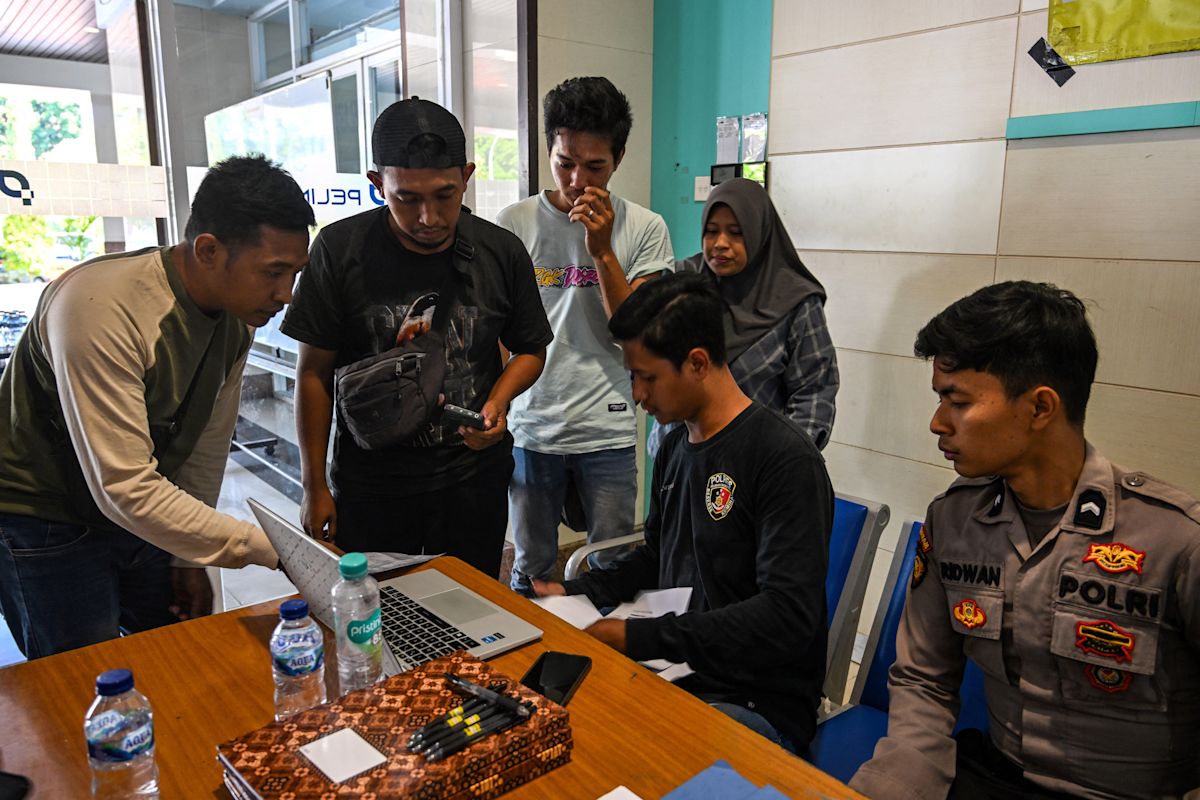
Relatives anxiously crowded around bulletin boards and official desks at the port, scanning survivor manifests and missing persons lists for any sign of family members. Local police officers and harbor staff spent hours interviewing relatives, including family members such as Ela Nur Atika, whose husband was aboard the ferry, to gather vital identifying details and confirm passenger identities.
Amid the tension and grief, some families experienced profound moments of relief upon learning that their relatives had been pulled safely from the sea. One woman, identified by the single name Bunga, described the emotional turmoil of searching for information after recognizing her uncle's name on the ship's passenger registry, before officials later confirmed that rescue teams had successfully brought him to safety.
Ferries represent an indispensable lifeline across Indonesia, a vast archipelagic nation that encompasses more than 17,000 separate islands stretching across thousands of miles of ocean. Millions of residents and tons of vital commercial freight rely daily on maritime transit links to travel between major population centers on Java and outer regional hubs like Kalimantan.
Despite their vital role in national connectivity, maritime transport accidents occur with regularity across Indonesian waters. Industry observers frequently point to weak regulatory enforcement, inadequate safety oversight, overcrowding, and unpredictable weather patterns as recurring factors contributing to serious incidents at sea.
As night approached over the Java Sea, search and rescue teams pledged to maintain their operations around the capsized Virgo Transport 8. With around 130 people still unaccounted for, emergency teams continue to scour the surrounding waters, hoping to locate survivors in one of the region's most challenging maritime search operations.







(0)