
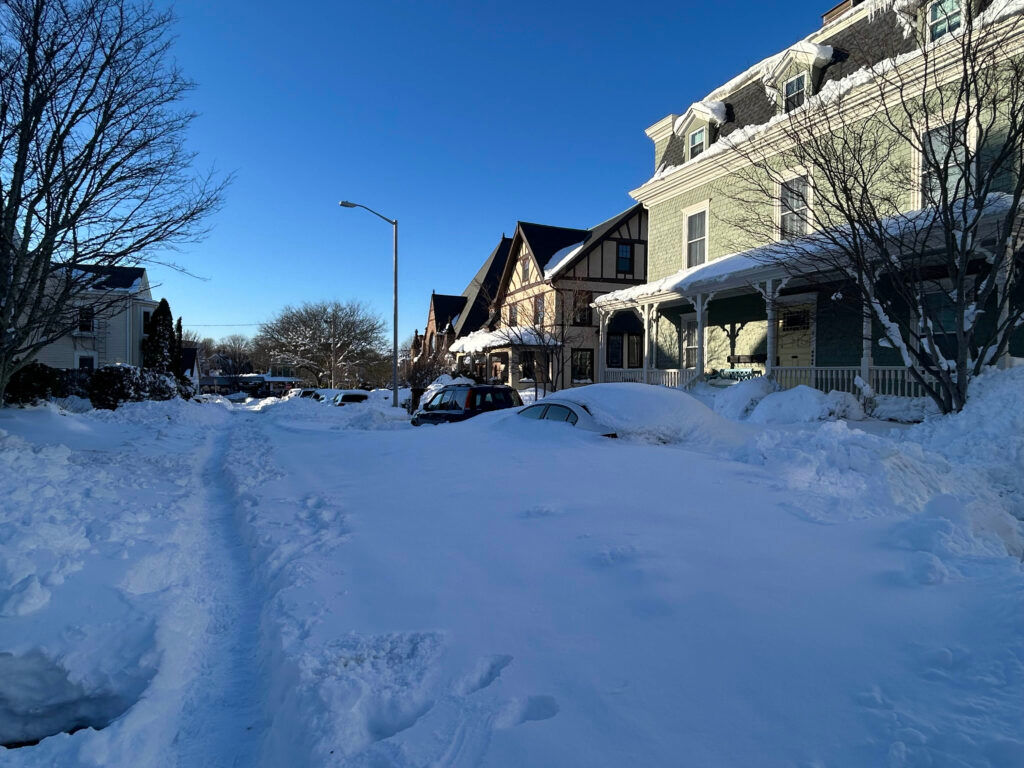
Rhode Island’s federal legislative delegation is pushing back vigorously against the Trump administration following the repeated refusal by federal emergency authorities to provide financial relief for a catastrophic winter storm. Members of Congress representing the state are demanding full transparency after the Federal Emergency Management Agency turned down funding requests meant to offset millions of dollars in emergency recovery and municipal cleanup expenses incurred during a record-setting storm in February 2026.
In a formal letter sent on September 9, U.S. Senators Jack Reed and Sheldon Whitehouse, together with U.S. Representatives Seth Magaziner and Gabe Amo, formally called upon FEMA and its parent body, the Department of Homeland Security, to retain and deliver all administrative documentation concerning the state’s aid petition. The lawmakers are seeking an exhaustive review of internal records to understand why Rhode Island was denied a major disaster declaration despite experiencing historic levels of damage and municipal disruption.
The conflict stems from the aftermath of a ferocious winter blizzard that struck the region in late February 2026, burying local communities under more than three feet of snow. The congressional delegation emphasized that the federal government must account for its decision-making process, requesting that both agencies turn over all communications, evaluations, and internal determinations connected to the state's disaster assistance filings.
Rhode Island Governor Dan McKee initially submitted a formal petition for $19 million in federal assistance on April 7, invoking the provisions of the Stafford Disaster Relief and Emergency Assistance Act. The statutory framework of the Stafford Act is designed to permit state governors to secure supplemental federal funding whenever severe weather events strike, or when the overall operational and financial burden of a disaster clearly outstrips the independent management capabilities of state and local entities.
Federal emergency officials initially dismissed the state’s disaster relief application on July 2. Unwilling to accept the outcome, Governor McKee submitted a comprehensive appeal, but FEMA reaffirmed its refusal in a second denial issued on September 2. The subsequent rejection prompted the governor to publicly criticize the administration's stance, describing the federal agency’s sustained denial of the state's blizzard relief request as a new low in disaster assistance cooperation.
Throughout the administrative back-and-forth, FEMA leadership declined to provide state officials with a specific or comprehensive justification for withholding the funds. In both official rejection notices, agency leadership utilized boilerplate phrasing, stating only that based upon a full review of available details, supplemental federal aid under the Stafford Act was not determined to be warranted for the state.
The state’s congressional delegation sharply criticized this lack of transparency, pointing out that federal officials had neglected to supply any written, detailed rationale explaining why the request was turned down. Lawmakers argued that Rhode Island had demonstrably surpassed FEMA's established thresholds for disaster assistance, making the federal government's unexplained silence particularly egregious for local leaders trying to balance storm-related budgets.
FEMA Administrator Cameron Hamilton sought to justify the decision on social media, posting on X on September 3 that the affected states had failed to supply new or compelling details in their administrative appeals. In his public statement, Hamilton downplayed the severity of the crisis by asserting that severe winter weather is not an unusual occurrence for the Northeast region, a stance that accompanied simultaneous relief rejections for similar requests from Massachusetts, New Jersey, and New York.
Rhode Island’s federal lawmakers quickly challenged Hamilton's characterization, arguing that the February 2026 blizzard was entirely distinct from typical seasonal weather. The delegation stressed that dismissing a record-shattering weather catastrophe as run-of-the-mill winter conditions was profoundly dismissive of the extensive disruptions suffered by local residents, workers, and business owners whose everyday operations were paralyzed by the disaster.
Meteorological records underscore the historic nature of the storm, which began pounding the state on Monday, February 23. Official measurements taken at Rhode Island T.F. Green International Airport recorded an extraordinary 37.9 inches of accumulated snow. That total easily eclipsed the state's previous all-time benchmark of 28.6 inches, which had stood undisturbed for nearly five decades since the historic Blizzard of 1978.
Beyond unprecedented snow accumulations, the storm unleashed severe atmospheric violence across the state, generating destructive wind gusts that reached up to 74 mph. Lawmakers and meteorologists noted that the system packed the destructive intensity and physical magnitude equivalent to a Category 2 hurricane, generating whiteout conditions, snapping utility lines, and plunging thousands of homes into darkness as power systems failed.
The financial toll of the blizzard was substantial, resulting in approximately $19 million in overall damages, emergency response expenditures, and lingering cleanup operations. The financial impact was split across government jurisdictions, with roughly $9 million incurred directly at the state government level and another $10 million absorbed by Rhode Island’s various cities and towns struggling to clear unplowed roads and restore public infrastructure.
In their communication to federal leaders, the members of Congress insisted that releasing internal agency communications and working papers is the only way to establish whether Administrator Hamilton’s rationale was grounded in legitimate administrative facts. Lawmakers emphasized that reviewing the complete administrative record will clarify the real factors behind FEMA's determinations and reveal whether agency staff adhered to established guidelines.
The delegation warned Homeland Security and FEMA leadership that if they refuse to preserve and disclose the requested records, local officials and the public will be left to conclude that the agency’s rationale is completely without merit. Lawmakers maintained that full transparency is vital to ensuring that federal emergency mechanisms are not arbitrarily applied to communities recovering from major natural disasters.
When contacted for a response regarding the congressional inquiry, spokespersons representing both FEMA and the Department of Homeland Security stood by the agency's official position. The spokespeople reiterated the perspective shared by Administrator Hamilton, asserting that the northeastern states appealing their denied blizzard aid had simply failed to present fresh evidence to justify reversing the initial administrative rulings.








(0)