
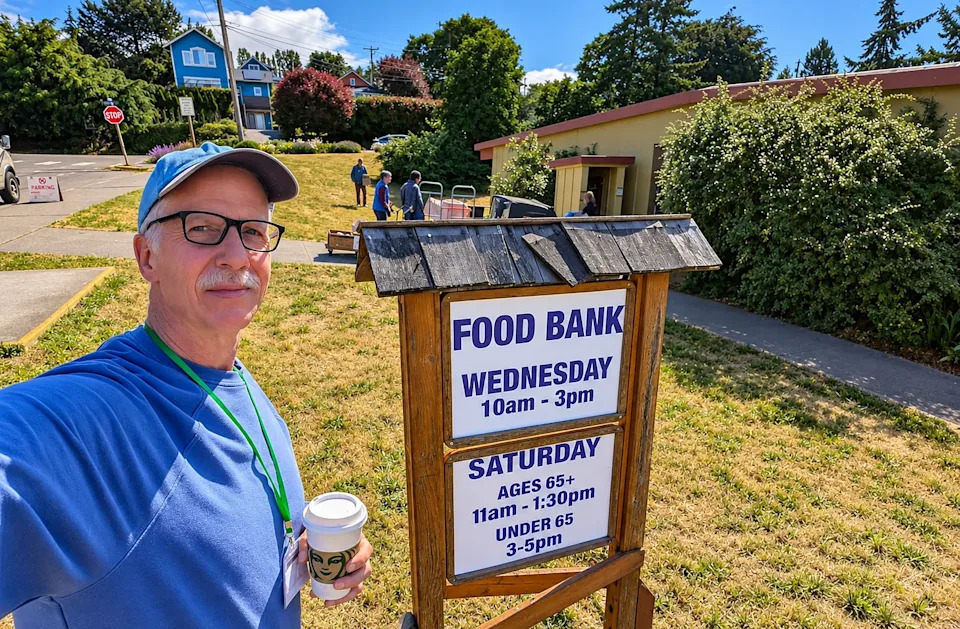
Across the United States, community food distribution centers are witnessing an influx of visitors as the rising cost of everyday essentials continues to squeeze household budgets. At a local food bank in Port Townsend, Washington, weekly operations reveal a sharp contrast between the daily struggles of low-income Americans and the dismissive narratives frequently promoted by high-profile tech billionaires. While critics from the upper echelons of wealth often characterize social safety net recipients through negative stereotypes, firsthand accounts from the distribution floor present a picture defined by humility, restraint, and mutual aid.
The environment inside the Port Townsend pantry reflects an escalating need across diverse demographics. Over the course of six months, more than one thousand individuals have sought nutritional support at the facility. The crowds consist of families with up to seven members, retired couples living on fixed incomes, individuals managing disabilities, and members of the working poor. Rather than displaying entitlement, clients routinely demonstrate a conscious effort to ensure other struggling community members do not go without basic sustenance.
A clear example of this dynamic occurred during a typical pantry shift involving Cal, a disabled man in his sixties whose frail physical condition was underscored by clothing hanging loosely from his frame. When offered a jar of all-natural peanut butter in addition to his standard allocation of tuna, rice, and tomato soup, he initially declined the item. Cal explained that because he lived alone and supplies appeared limited, the food should instead be reserved for a household with children. It was only after volunteers assured him that ample reserves remained in the back storage room that he agreed to accept the jar.
Such encounters stand in direct opposition to public rhetoric from figures such as Elon Musk, who recently circulated a meme characterizing Americans relying on federal assistance programs as members of a "parasite class." This characterization assumes that low-income recipients are eager to exploit public systems for personal gain. However, distribution logs and volunteer interactions challenge this premise, demonstrating that the vast majority of recipients prioritize communal fairness over individual accumulation.
Out of more than a thousand individuals served at the Port Townsend location, pantry staff noted that exactly two people had ever requested more provisions than appeared reasonable. Furthermore, there has been no indication of clients taking free groceries to resell them for profit. Instead, volunteers frequently hear visitors expressing concern about taking more than their fair share, asking if enough supplies remain for others, or requesting that specific goods be saved for larger families. In many instances, workers must actively encourage clients to take additional items.
This spirit of community assistance extends beyond immediate households. One regular visitor, a mother named Janet who gathers groceries for her family of six, routinely uses her shopping trip to collect provisions for disabled neighbors who are physically unable to visit the facility themselves. Similarly, another recipient collecting bulk ingredients to prepare a large batch of chili made sure to clarify that the meal was intended to feed both his household and his sister’s family, who had not yet registered with the pantry.
The demographic reality of modern food bank clients also dispels misconceptions regarding employment. Many individuals who rely on food pantries are actively employed in essential or low-wage sectors where compensation fails to keep pace with rapid price inflation. Volunteers have reported handing groceries to workers in the morning only to encounter them working shifts at fast-food restaurants later that afternoon. In another instance, a nursing home aide routinely arrives at the pantry directly following an exhausting overnight shift to ensure her children have adequate food.
Supporting these community operations requires substantial physical labor, largely carried out by older and retired volunteers. Heavy delivery trucks arrive weekly containing items nearing expiration from grocery retailers, agricultural contributions from local farms, and shipments from regional redistribution hubs. The elderly workforce unloads these vehicles, washes and prepares fresh produce, breaks down large quantities of cardboard, restocks pantry shelving, cleans the facilities, and manages client intake alongside volunteer administrative logs.
Notably, a considerable number of the volunteers managing these demanding logistical tasks are food bank clients themselves. Having firsthand experience with food insecurity, these community members invest their own time and labor into maintaining the distribution network that keeps their neighbors fed.
These grassroots realities stand in stark contrast to the commentary and policy stances of ultra-wealthy executives. While leaders like Jeff Bezos have suggested that the bottom half of American earners should be exempt from federal income taxes, and Mark Zuckerberg has voiced sympathy for arguments against excessive billionaire wealth, their practical proposals often focus heavily on artificial intelligence as a universal fix for socioeconomic hardship.
However, many analysts and economists caution that unregulated artificial intelligence could exacerbate existing economic divides rather than alleviate them. Furthermore, policy measures championed by tech leaders have actively restricted safety net funding. Under Musk’s Department of Government Efficiency (DOGE) initiative, approximately one billion dollars in United States Department of Agriculture funding was eliminated, cutting critical financial streams that allow food banks to purchase goods directly from local agricultural producers.
The critique of public assistance programs also highlights deep disparities in the American financial system. While figures like venture capitalist Peter Thiel frequently voice grievances regarding high taxation, comprehensive analyses indicate that ultra-wealthy individuals contribute relatively small proportions of their total wealth gains. Estimates from investigative outlet ProPublica reveal that billionaires typically pay effective tax rates between 3 and 10 percent when accounting for stock growth, with the nation's 25 richest individuals paying an estimated true tax rate of roughly 3.4 percent.
Ultimately, the daily operations within local food pantries demonstrate that the struggle against poverty is defined by hardworking individuals and mutual sacrifice. Rather than exploiting the system, those navigating economic instability frequently show deep concern for their neighbors, contrasting sharply with the detached characterizations put forward by the nation's wealthiest commentators.







(0)