
As the 2026 midterm election campaign heads into its final seven weeks, the high-profile race for the United States Senate in Texas has become a major proving ground for political artificial intelligence. Digital alterations and synthetic clips are circulating widely across digital platforms, fundamentally altering the way candidates communicate with voters and attack their rivals.
While the concept of artificial intelligence once required technical explanation, the shorthand term "AI" has become a routine fixture of daily political discourse. Within tech and political circles, these digitally altered videos are known as deepfakes because they present fabricated scenarios with lifelike realism. Modern software now allows almost anyone with basic computer literacy and access to authentic imagery to generate convincing synthetic clips quickly, easily, and at minimal cost.
The presence of parody and biting satire in American campaigns is as old as the republic itself, tracing back to the era of powdered wigs and early editorial cartoonists. However, early political caricatures produced centuries before the advent of photography or editing software like Photoshop never risked misleading the electorate into believing the drawings captured real life. By contrast, modern generative tools allow campaigns to produce realistic visual depictions that can blur the line between satire and deception.
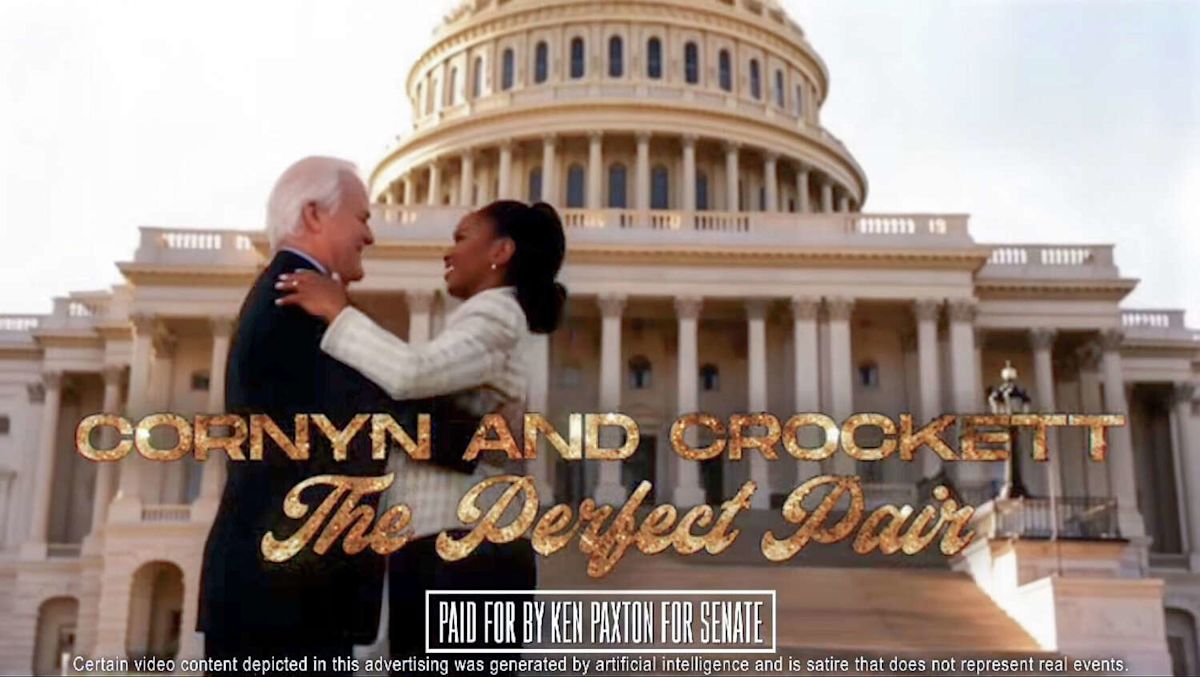
During the contentious Republican primary and subsequent runoff campaign, Texas Attorney General Ken Paxton leaned heavily into the technology to weaken incumbent U.S. Sen. John Cornyn. Paxton’s campaign released an AI-generated video showing a smiling Cornyn dancing cheek to cheek with Democratic U.S. Rep. Jasmine Crockett, who was also running for Senate.
Paxton’s advertisement paired the fabricated dance sequence with authentic video excerpts of Crockett discussing past moments where she and Cornyn had cooperated on bipartisan legislative proposals. The juxtaposition was designed to challenge Cornyn’s conservative credentials among the primary electorate by portraying him as overly cozy with Democratic lawmakers.
Rather than dismissing the tactic, Cornyn answered with his own sophisticated deepfake counterattack. The incumbent senator’s campaign released a digitally produced ad depicting Paxton driving along inside a 1960s-era convertible to the tune of a cover version of the B-52s’ party track "Love Shack."
The imagery carried a deliberate political bite, intended to remind Republican voters of the personal controversies and alleged extramarital dalliances that have surrounded the attorney general and led his wife to file for divorce. By leaning into humor and popular music, Cornyn sought to spotlight Paxton’s personal record ahead of the decisive party vote.
Whether these high-tech salvos fundamentally shifted voter sentiment remains open to debate. Cornyn secured the highest number of votes during the March Republican primary, but his margin was insufficient to prevent a runoff. In the subsequent runoff election, Paxton secured the Republican nomination with a decisive landslide victory.
The conclusion of the Republican primary did not mark the end of deepfakes in the general election campaign. Paxton has continued to deploy generative media in his race against his general election opponent, Democratic nominee James Talarico.
Talarico secured the Democratic nomination after defeating Crockett without being pushed into a runoff. A 37-year-old seminarian who openly discusses his Christian faith while campaigning, Talarico has drawn criticism from Christian Republicans who argue that his progressive theology conflicts with their traditional religious convictions.
Paxton’s latest synthetic video zeroes in on these religious disputes by portraying Talarico digitally revising biblical text. In the clip, the Democratic candidate is depicted altering scripture to declare that God created six biological sexes and asserting that Jesus was a radical feminist.
The visual execution of the attack video renders Talarico looking and sounding roughly twenty years younger than his actual age. In reality, Talarico had previously stepped back from the "six genders" remark, explaining that his initial formulation was a clumsy attempt to articulate a broader point.
The increasing prevalence of synthetic political media has previously prompted legislative scrutiny in Austin. In 2019, the Texas Legislature passed a law prohibiting the distribution of deceptive deepfake videos during the final 30 days before an election.
However, the state statute does not extend to federal contests, leaving congressional and U.S. Senate campaigns outside its regulatory reach. State Sen. Bryan Hughes, a Mineola Republican who authored the 2019 measure, has maintained that the law was designed to curb fraudulent manipulation while continuing to protect foundational free speech principles.
The rapid rise of deepfakes reflects an ongoing collision between emerging generative technology and constitutional protections. While political satire and provocative attacks have enjoyed First Amendment protection since the founding of the nation, the widespread availability of synthetic video ensures that AI will remain a powerful and disruptive force in Texas politics.







(0)