
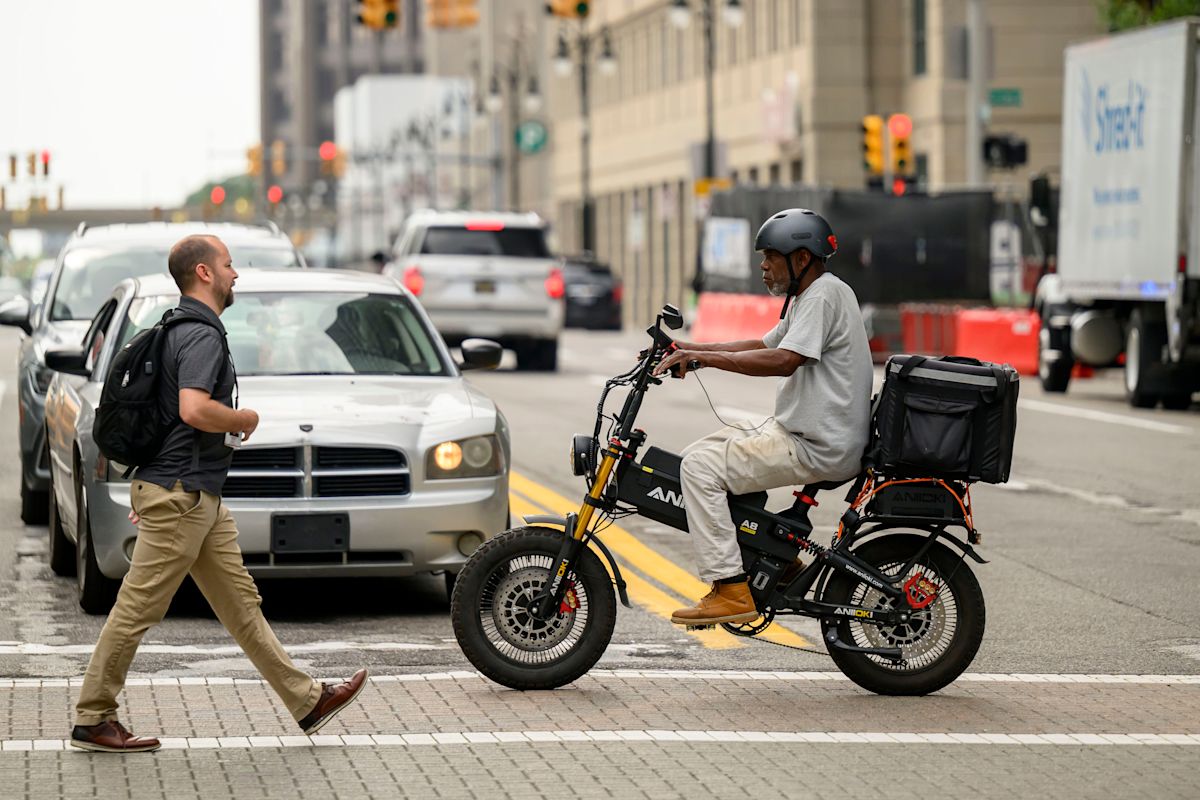
Elected officials in Warren have joined a growing list of Michigan municipal leaders seeking solutions to the rapid proliferation of high-speed electric bicycles, minibikes, and electric motos. During a recent meeting, members of the Warren City Council expressed mounting alarm over public safety hazards created when young riders operate these fast-moving motorized machines on shared pedestrian paths and community sidewalks.
The local policy discussion was spearheaded by Council Secretary Mindy Moore, who scheduled the topic to address community concerns regarding how these motorized devices are utilized across the city. Moore had sought to integrate law enforcement perspectives into the municipal dialogue, intending to review current operational patterns and determine how existing traffic codes might apply to motorized two-wheelers.
However, the council's review encountered immediate administrative friction regarding departmental participation. Moore stated that she had hoped representatives from the Warren Police Department would be present to deliver crucial data and operational insight, but claimed the department had been directed not to cooperate with the council during the session.
In response to those claims, city administration officials disputed that there had been any deliberate effort to withhold police assistance. Clarissa Cayton, serving as a spokesperson for Warren, explained that no formal inquiry had been submitted to the Mayor's Office from the City Council requesting an official police presentation on local electric bike usage. A representative for the police agency was unavailable for immediate comment following the late-night session.
Following preliminary deliberations among the council members regarding the scope of the problem, the governing body ultimately voted unanimously to table the matter. The postponement will allow officials more time to study appropriate regulatory frameworks and explore legal avenues before enacting municipal ordinances.
Moore emphasized the critical nature of the issue during the meeting, acknowledging that establishing workable enforcement mechanisms remains a complex hurdle for local government. Among the potential enforcement strategies she highlighted were granting police officers the authority to impound non-compliant bikes or instituting substantial monetary fines against parents whose children jeopardize pedestrian safety with high-powered models.
To illustrate the everyday risks within residential and commercial zones, Moore shared a personal observation from a visit to a local nail salon. While there, she witnessed a group of seven or eight youths on minibikes performing stunts and wheelies while speeding along the pedestrian sidewalks, demonstrating how widespread the trend has become in public spaces.
In addition to punitive measures, Moore suggested proactive educational campaigns across local school systems. She proposed that the Warren Crime Commission could coordinate school visits to instruct students and their families directly on the operational hazards, legal boundaries, and responsibilities associated with riding fast-moving motorized bikes.
Councilman Jonathan Lafferty voiced strong agreement regarding the physical dangers posed by these vehicles. He recounted an incident where he was driving his automobile at the posted 25 mph speed limit, only to be suddenly overtaken by a youth riding a minibike on the adjacent sidewalk at an estimated speed exceeding 30 mph.
Lafferty cautioned that the potential for severe physical trauma is an urgent reality that local leaders cannot afford to ignore. He stressed that having motorized vehicles traveling at highway speeds alongside walking pedestrians creates an unacceptable public safety environment that requires prompt intervention.
The debate in Warren reflects broader regulatory actions taking place throughout southeastern Michigan. Just a day prior, the Bloomfield Township Board of Trustees approved a six-month moratorium that bars individuals under the age of 16 from operating e-bikes and motorized scooters on public sidewalks, empowering local officers to confiscate equipment from violators during the temporary ban.
The push for tighter restrictions across the region follows several catastrophic accidents involving young riders. Most notably, two 13-year-old boys in Bloomfield Township suffered critical injuries on Labor Day after a severe collision involving electric motos and a truck, bringing intense community scrutiny to youthful e-bike operation.
Public safety disruptions involving motorized bikes have surfaced across other regional settings as well. In neighboring Oakland County, a public school district recently enacted a complete prohibition on e-bikes on school grounds, while another recent incident saw teenagers on e-bikes ride directly onto an active airport runway, forcing an approaching airplane to abort its landing.
The surge in collisions has also reshaped the local legal landscape, prompting prominent personal injury practices, such as the Sam Bernstein Law Firm, to actively advertise dedicated legal representation for victims of Michigan e-bike crashes.
At the state level, lawmakers are moving to establish statewide age limits and operating standards. State Sen. Jim Runestad introduced legislation in the Michigan Senate aimed at prohibiting anyone under the age of 14 from riding Class 1, 2, or 3 electric bicycles on public streets, sidewalks, and recreation trails, while requiring riders aged 14 to 18 to wear safety helmets and secure parental consent.
Runestad underscored that modern electric bikes operate as motorized transport rather than simple toys, noting their capability of reaching speeds between 20 and 30 mph. He warned that young children often lack the necessary developmental coordination, mature judgment, and road experience to navigate traffic safely, urging lawmakers to close regulatory gaps before further serious injuries occur.







(0)