
Belgian physicist Prof Francis Halzen has been awarded the Nobel Prize in Physics for his groundbreaking contributions to the development of an Antarctic observatory that detects elusive particles from deep space, opening a new window onto the most violent and distant phenomena in the universe.
The Royal Swedish Academy of Sciences announced the award on Tuesday, citing Halzen's "decisive contribution" to the creation of the IceCube Neutrino Observatory. The academy praised what it described as his vision and scientific leadership, which it said have been fundamental to the project's success.
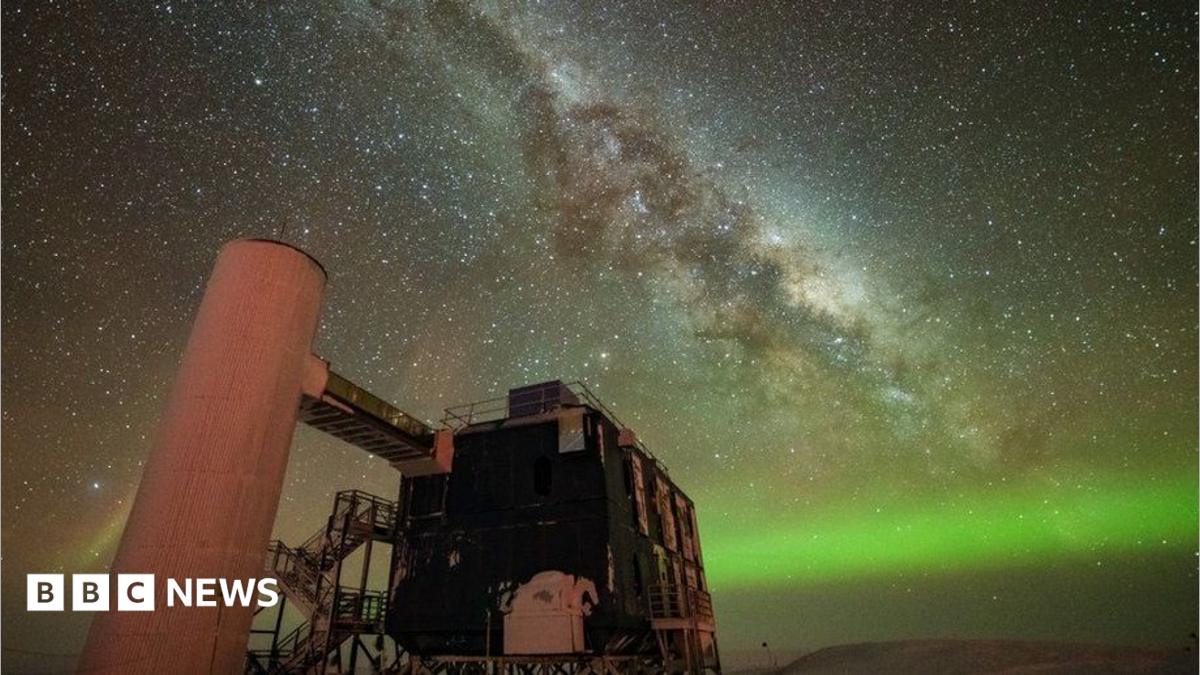
Halzen spearheaded the construction of IceCube at the South Pole, an extraordinary instrument that transforms a cubic kilometre of Antarctic ice into a giant particle detector. The observatory is fitted with thousands of light sensors embedded deep within the ice, designed to catch the faint signals produced when neutrinos interact with the frozen environment.
Neutrinos are among the most mysterious and abundant subatomic particles in existence. They are produced in staggering quantities by the Sun, with billions passing harmlessly through an area the size of a human fingernail every single second. Because they interact so rarely with matter, they can travel across the cosmos virtually unimpeded, carrying with them information about their origins.
However, IceCube is not primarily concerned with the relatively low-energy neutrinos streaming from our own star. Instead, it hunts for far more energetic neutrinos, particles generated by extreme and violent processes occurring well beyond our Solar System, in distant galaxies and other remote cosmic environments. These high-energy neutrinos serve as astronomical messengers, pointing scientists toward some of the most fundamental and powerful events in the universe.
Mark Pearce, Chair of the Nobel Committee for Physics, highlighted the significance of Halzen's achievement. He noted that Halzen has led an international team of researchers and engineers who have provided the world with a remarkable instrument. Pearce also emphasised that Halzen's tenacity and scientific vision have paved the way for an entirely new kind of astronomy.
The concept behind IceCube took shape decades ago. Halzen first presented his vision for detecting neutrinos at the South Pole in 1988, a time when the idea of using Antarctic ice as a particle detector was considered highly ambitious. His persistence over the following decades transformed that vision into one of the most productive scientific facilities on Earth.
The way IceCube operates is both elegant and remarkably sensitive. The vast majority of neutrinos passing through the ice leave no trace whatsoever. But on rare occasions, a neutrino collides with an atom in the ice, producing secondary particles that emit a distinctive flash of light. These fleeting signals, captured by the observatory's sensors, carry crucial clues about where the neutrino originated and what extreme conditions produced it.
This capability allows scientists to investigate environments that conventional telescopes struggle to observe. Traditional astronomy relies on light across the electromagnetic spectrum, from radio waves to gamma rays. Neutrinos, by contrast, can escape from regions where light cannot, such as the dense cores of exploding stars or the chaotic surroundings of supermassive black holes. By detecting them, researchers gain access to information that would otherwise remain hidden.
The recognition of Halzen's work underscores the growing importance of multimessenger astronomy, a field in which scientists combine observations from different types of signals, including light, gravitational waves and neutrinos, to build a more complete picture of cosmic events. IceCube has become a central pillar of this emerging approach.
The award also draws attention to the collaborative nature of modern physics research. IceCube is a massive international undertaking, involving hundreds of scientists and engineers from institutions around the world. The observatory's success reflects not only Halzen's leadership but also the collective effort of a global scientific community dedicated to unlocking the secrets of the universe.
For Halzen, the prize represents the culmination of a career defined by a bold idea and an unwavering commitment to pursuing it. What began as a speculative proposal in the late 1980s has grown into a facility that routinely delivers discoveries about the most energetic processes in nature, from the acceleration of particles in distant galaxies to the behaviour of matter under conditions impossible to reproduce on Earth.
The Nobel Committee's decision to honour this work signals a strong endorsement of neutrino astronomy as a vital and maturing field. As IceCube continues to collect data and as planned upgrades expand its capabilities, scientists expect that the observatory will yield further insights into the cosmos, building on the foundation that Halzen and his colleagues have established.
The award serves as a reminder that some of the most profound discoveries come from pursuing questions that once seemed unanswerable. By turning a cubic kilometre of polar ice into a sophisticated telescope for ghostly particles, Halzen has given humanity a new sense with which to perceive the universe, one that promises to reveal secrets long concealed from conventional observation.





(0)