
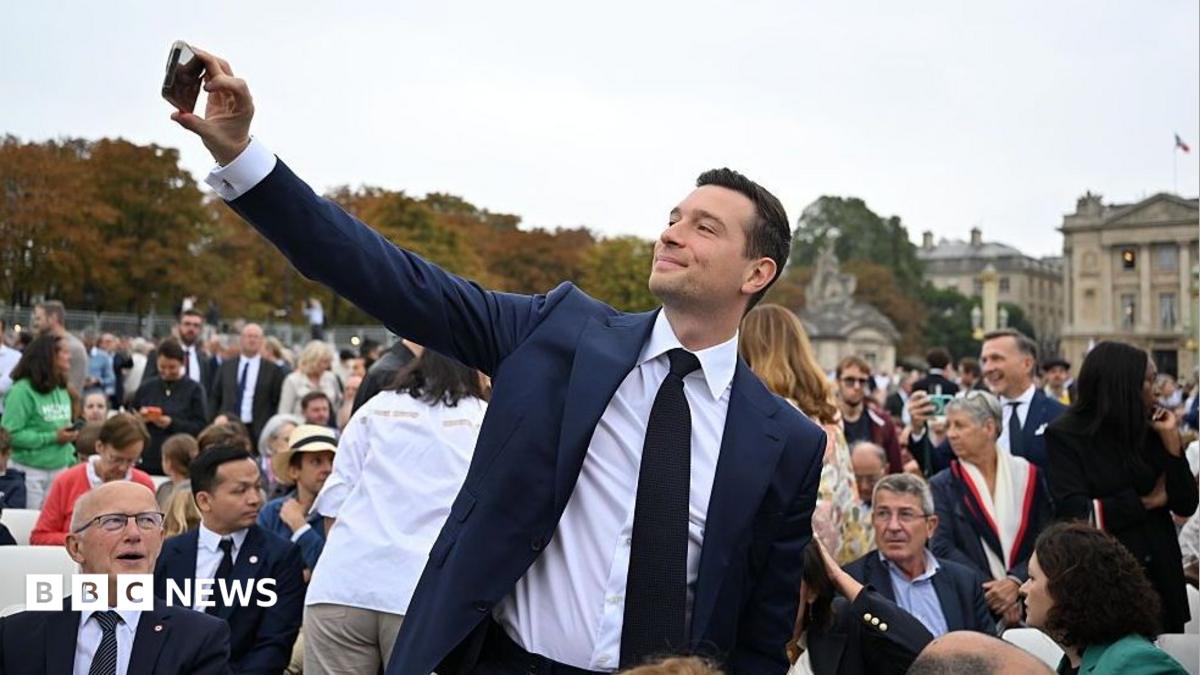
Jordan Bardella, the president of France's hard-right National Rally (RN), has announced he will pursue a libel action after the investigative outlet Mediapart published a report alleging that he made antisemitic remarks as a young activist more than a decade ago. The controversy lands with just seven months remaining before France's presidential election, injecting a volatile new element into a campaign that the RN had been approaching with unusual confidence.
According to the BBC's reporting from Paris, Mediapart said its findings stemmed from "several months" of investigation into "dozens of written conversations" that Bardella allegedly conducted in 2013. The outlet described the material as part of "a bigger documentary base corroborated by witness statements," and said it had "independently authenticated" the conversations. Notably, Mediapart did not publish screen-grabs of any of the alleged remarks, a decision that Bardella's allies have seized upon as evidence of the report's weakness.
Among the statements Mediapart attributes to Bardella when he was 17 or 18 are claims that "all the banks are owned by Jews," that "the Jew has to dominate other people, crush them and rob them," and that "what they want is a new world order dominated by Israel, with of course Jerusalem as its capital." The alleged comments invoke blatantly antisemitic tropes that the RN has spent years attempting to expunge from its public identity.
Bardella, 31, responded forcefully to the allegations, framing them as part of a broader effort to sabotage his party. Speaking to CNews television on Monday night, he warned of "the beginnings of a total war" aimed at destabilising the RN's ascent. "Everything is going to be done to destabilise the campaign," he said, adding that either Mediapart was running the operation itself or was "being manipulated by interested parties." He confirmed that he had instructed his lawyer to sue for libel.
The RN's presidential candidate, Marine Le Pen, offered her full backing to Bardella, who would likely serve as prime minister if she wins next year's election. Le Pen said the alleged remarks "seem so weird that they can only be a forgery — one of those dirty tricks for which Mediapart appears to hold the secret." Her intervention underscores how closely the party's leadership has closed ranks around its most prominent young figure.
Mediapart is an avowedly leftwing website with a long record of exposing scandals, and its targets over the years have included politicians across the political spectrum. That history complicates any attempt to dismiss the outlet as a purely partisan actor, even as Bardella's supporters question the absence of direct documentary evidence in the published report. The dispute now turns on competing claims about verification and motive that may ultimately be tested in court.
The timing could hardly be more sensitive. The French hard right is riding higher than ever in pre-election polling, and the latest survey this week from Toluna-Harris showed Le Pen as a clear victor over any rival she might face in the crucial second round in May. According to the poll, Le Pen would take 35-36% of the vote in the multi-candidate first round, with her likely run-off opponent, Jean-Luc Mélenchon of the radical left, suffering a decisive defeat by 69% to 31%.
In a stark warning for the political establishment, the same survey indicated that Le Pen would also comfortably beat Edouard Philippe, the most popular centrist candidate, by a margin of 57%. On Sunday, the RN received a further boost when results from a partial election for the upper house of parliament, the Senate, produced for the first time enough seats for the party to form an official group. Together, the polling and the Senate result suggest a party transitioning from protest movement to genuine institutional force.
Under Marine Le Pen, daughter of the party's historic founder Jean-Marie Le Pen, the RN has made enormous efforts to distance itself from the French far right's antisemitic roots. Last year, Bardella became the first senior figure from the party to be invited to Israel, attending a conference on antisemitism. Today the party regards militant Islam as a pre-eminent threat — a position it shares with many French Jews — and even styles itself as a "shield for the Jewish community."
The alleged comments attributed to Bardella, however, throw back to a current of far-right thinking that Mediapart says has never been eradicated but merely covered up in the party's new-look incarnation. Leftwing politicians responded by calling on Bardella to resign, while Yonathan Arfi, head of the Jewish umbrella organisation Crif, said the alleged remarks "were an illustration of the limits of the RN's clean-up act." The reactions suggest the affair could reopen a sensitive debate about whether the party's transformation is substantive or cosmetic.
The RN has pushed back hard against that narrative. Party deputy Jean-Philippe Tanguy claimed the source of the allegations was disaffected former members who had been expelled years ago because of their antisemitic ideas. "From what I know, it is the antisemitic rabble that were so bravely purged by Marine Le Pen," he said. "At the start of the 2010s, they were numerous and well-organised, but they were defeated. These people have always had it in for us."
That defence effectively acknowledges the party's past while arguing that the purge was real and the remnants are hostile. Whether voters accept that framing may determine how much damage the affair inflicts. With Le Pen leading comfortably in the polls and the RN celebrating its new Senate grouping, the party's opponents now have a fresh line of attack centred on questions of authenticity and the durability of its reinvention.
Bardella's threatened libel suit raises the stakes further, potentially shifting the battleground from the court of public opinion to a French courtroom where the authenticity of the alleged conversations would be examined in detail. For a 31-year-old widely seen as the RN's future, the outcome could shape not only his own trajectory but also the party's carefully constructed image as it bids for the presidency.
The broader political context remains unsettled. As the BBC's related coverage notes, the RN's international posture has also drawn attention, including a small boats deal unveiled with Reform UK leader Nigel Farage. Meanwhile, Le Pen herself is fighting a court conviction while running for the presidency, adding another layer of legal uncertainty to an already unpredictable contest. The antisemitism row now sits alongside those issues as part of a volatile pre-election landscape.
For now, the RN's leadership is presenting a united front, with Le Pen's declaration of total confidence in Bardella signalling that the party intends to contest the allegations rather than retreat. Mediapart, for its part, has stood by its reporting and its verification process. With seven months until the vote, the confrontation between the two sides is likely to intensify, and the question of what a 17-year-old activist wrote in private messages more than a decade ago may become a defining issue of the campaign.






(0)